

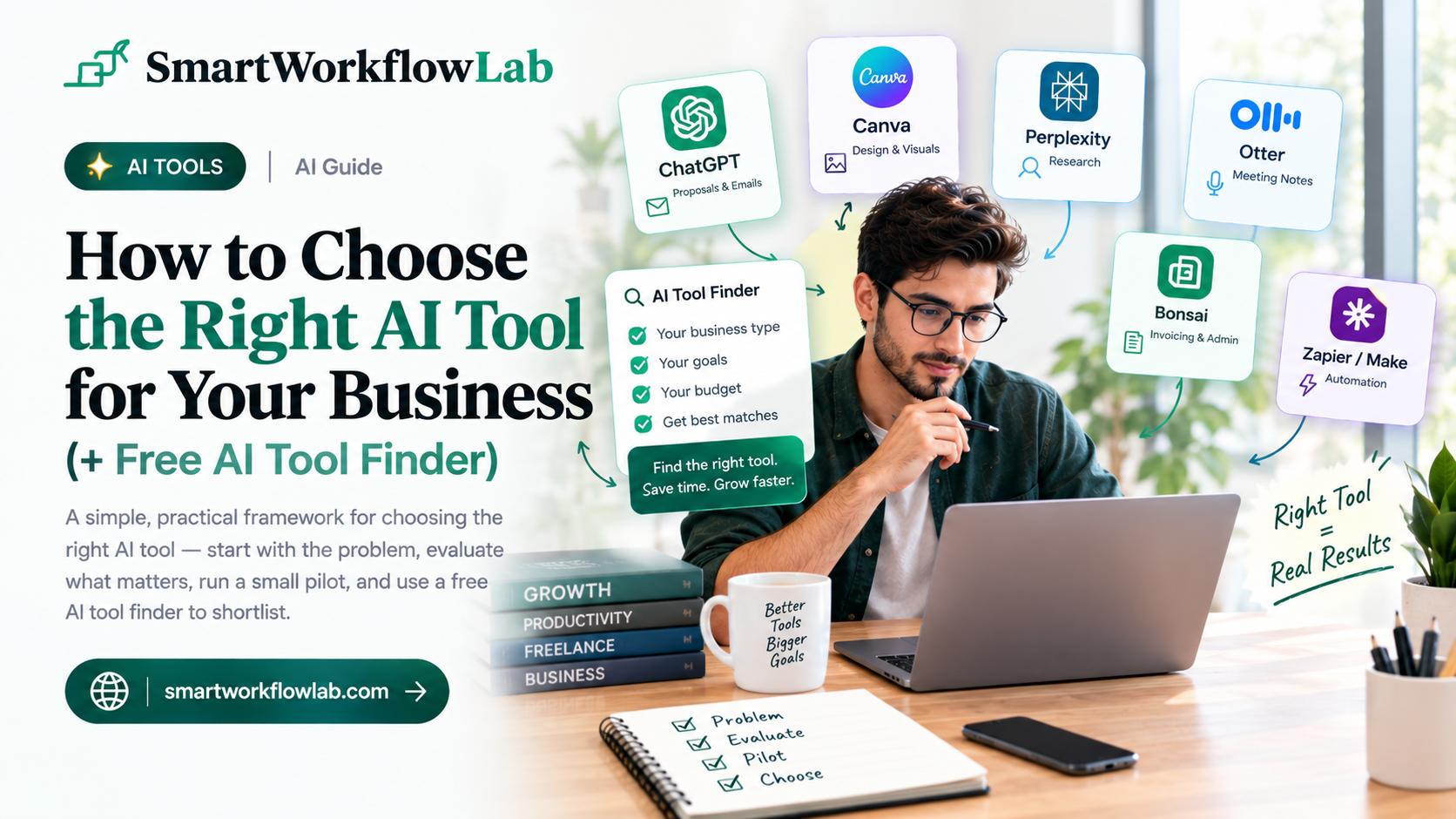
A new AI tool launches what feels like every week, each one promising to transform your business. That’s exactly the problem. Finding AI tools has never been easier; choosing the right one has never been harder. And the cost of choosing wrong is real — money spent on subscriptions nobody uses, hours lost learning a platform that doesn’t fit, limitations you only discover after you’ve committed.
The businesses that get value from AI aren’t the ones with the most tools or the newest ones. They’re the ones with a simple method for cutting through the noise: start with the problem, evaluate what actually matters, test small, and scale only what works. No framework, and you’re just buying on hype and hoping.
This guide gives you that method in plain language — no jargon, no fifty-tool comparison — plus a free AI tool finder to help you shortlist. Follow it and you’ll pick tools with confidence instead of guesswork.
The Short Answer
Choosing the right AI tool comes down to one shift in thinking: start with the problem you’re solving, not the tool you’re excited about. Write down the tasks eating your time, then look only at tools that fix those specific tasks — and judge them on whether your team will actually use them, not on their feature list.
Then, before you commit, run a tiny pilot: one task, one person, two weeks. If it beats how you did things before, keep it. If not, move on. That single discipline — test before you buy — separates the businesses that win with AI from the ones drowning in unused subscriptions.
Here’s the full method, step by step.
Step 1: Start With the Problem, Not the Tool
This is the step almost everyone skips, and it’s the most important. Before you look at a single tool, write down the two or three real problems you want AI to solve. Be specific: “I lose two hours a day answering repetitive customer emails,” not “we should use more AI.”
A clear problem statement does something powerful — it instantly eliminates most of the market. Suddenly you’re not comparing hundreds of tools; you’re comparing the handful that solve your exact problem. Choosing based on the job you need done, rather than what’s trending, is what builds an AI setup that’s easy to adopt and actually gets used.
Step 2: Define What Success Looks Like
Once you know the problem, define what a win would look like in plain terms. “Save three hours a week.” “Cut the time to write a proposal in half.” “Answer every customer within an hour.” A concrete target gives you a baseline to measure against later, so you can tell whether a tool actually delivered or just felt busy.
Without this, you’ll judge tools on vibes and demos. With it, you’ll judge them on results — which is the only thing that matters.
Step 3: Evaluate the 6 Things That Actually Matter
Now compare your shortlist on the criteria that decide whether a tool succeeds or gathers dust. Not the feature list — these six.
| What to check | The question to ask |
|---|---|
| Fit | Does it solve your specific problem, or just something nearby? |
| Integration | Does it connect to the tools you already use (email, CRM, docs)? |
| Ease of use | Will your team actually adopt it, or avoid it? |
| Output quality | Are the results reliable enough to use with light editing? |
| Security and privacy | Where does your data go, and is that acceptable? |
| Total cost | Beyond the subscription — setup, learning, and usage costs? |
Two of these matter more than people expect. Integration comes before features: a brilliant tool that doesn’t connect to your systems creates a silo nobody uses. And ease of adoption beats power: the best AI tool for your business is the one your team will actually use, not the most advanced one they quietly avoid.
On cost, look past the sticker price to total cost of ownership — setup time, the learning curve, the hours spent rolling it out, and any usage-based charges that grow with volume. For anything with usage-based AI pricing, our guide on estimating AI API costs helps you avoid a surprise bill.
Step 4: Shortlist It (Use the Free AI Tool Finder)
Even after you’ve narrowed things down, the sheer number of options can stall you. This is where a finder helps: instead of scrolling endless “best AI tools” lists, you tell it your task, budget, and needs, and it hands you a short list worth evaluating.
Our free AI Tool Finder does exactly that — it takes your specific need and narrows hundreds of tools down to a handful that fit, so you can skip straight to the part that matters: testing the ones that could actually work. It’s the fastest way to go from overwhelmed to a real shortlist. For no-cost options specifically, our roundup of free AI tools for small business is a good companion.
Step 5: Run a Small Pilot Before You Commit
Never buy on the strength of a vendor demo. Demos are designed to look perfect; your business is messier. The only reliable test is a small pilot in your real world.
Keep it tiny: one task, one person, one success metric, one to two weeks. Use the free tier or trial. At the end, compare the results against your baseline from Step 2 and gather honest feedback on how it felt to use. A good pilot tells you whether the tool works in your world, not just in the sales pitch — and it’s cheap insurance against a costly commitment to the wrong platform.
Step 6: Scale Only What Works
If the pilot beat your baseline and your team liked using it, roll it out more widely — and keep tracking results from day one. If it didn’t, drop it without regret; a failed two-week pilot is a small, smart loss.
Then resist the urge to add five more tools at once. Get one working and embedded first, and only add the next when a new, specific problem justifies it. Focus on outcomes, not on collecting tools.
Red Flags and Traps to Avoid
A few things that reliably lead to wasted money and unused software:
- Buying on hype or brand recognition. The most talked-about tool isn’t automatically right for your problem. Fit beats fame.
- Ignoring integration. A tool that doesn’t connect to your existing systems becomes an island your team abandons.
- Underestimating adoption. If a tool needs heavy training or changes how people work, expect resistance. Easy wins get used.
- Missing hidden costs. Setup time, training, and usage-based charges can dwarf the subscription. Count the whole thing.
- Skipping the pilot. Committing straight from a demo is how businesses discover a tool’s limits after they’ve paid for a year.
The Quick Checklist
The whole method, condensed to run through before any AI purchase:
- Have I written down the specific problem this solves?
- Do I know what success looks like, in a number?
- Does it fit my exact need, not just something close?
- Will it connect to the tools I already use?
- Will my team actually use it without a struggle?
- Is the data handling acceptable for my business?
- Have I counted the total cost, not just the subscription?
- Have I run a small pilot and beaten my baseline?
If you can tick these, you’re buying with evidence instead of hope.
How SmartWorkflowLab Helps
We test AI tools in real workflows before recommending them, which means we’ve watched plenty of impressive-looking tools fail the only test that matters — whether real people actually use them to get real work done. That’s why our approach starts with your problem and ends with a pilot, not with a feature comparison.
If you’re trying to choose between AI tools, or you’ve collected a few subscriptions and want to figure out which are worth keeping, our free finder and our practical, no-hype guidance are built for exactly that.
Frequently Asked Questions
1. How do I choose the right AI tool for my business?
Start with the problem, not the tool. Write down the two or three tasks costing you the most time, define what success would look like, then evaluate only the tools that solve that specific problem on fit, integration, ease of use, cost, and security. Run a small pilot before committing, and scale only what works.
2. What is the biggest mistake when choosing an AI tool?
Buying on hype instead of need — picking the most talked-about tool without checking whether it fits your workflow, connects to your existing systems, and is something your team will actually use. The best AI tool is the one people use, not the most advanced one that sits unused.
3. Should I look at features or price first?
Neither — look at fit first. A clear statement of the problem you are solving eliminates most of the market instantly. Then compare only the tools that solve that problem, weighing integration and ease of adoption above a long feature list, and judging cost as total cost of ownership rather than the sticker price.
4. How do I test an AI tool before paying for it?
Run a small pilot. Pick one task, one person, and one success metric, use the free tier or trial for a week or two, and compare the results against how you did it before. A pilot shows whether the tool works in your real world, not just in a polished vendor demo.
5. What does total cost of ownership mean for AI tools?
It is the full cost beyond the subscription — setup time, the learning curve, the hours your team spends adopting it, and any usage-based charges that scale with volume. A cheap-looking tool can cost more once you count the time to roll it out, so weigh the whole picture.
6. How many AI tools should my business use?
Fewer than you think. Adopt one tool for your biggest bottleneck, make it a habit, then add another only when a new problem justifies it. A small, well-used set of tools beats a large collection of subscriptions your team logs into once and forgets.
7. How do I know if an AI tool is secure enough?
Check what data it processes and where that data goes, since many AI tools handle internal documents and customer information. Avoid putting sensitive data into tools without clear privacy terms, confirm it meets your industry’s requirements, and involve IT before committing for anything business-critical.
8. What is an AI tool finder?
It is a tool that helps you shortlist AI software by your needs — your task, budget, and requirements — instead of scrolling through endless lists. It narrows hundreds of options down to a handful worth evaluating, which is the fastest way to go from overwhelmed to a real shortlist you can pilot.
Final Thoughts
The hardest part of AI in 2026 isn’t finding tools — it’s choosing well among too many. But the method is refreshingly simple: begin with the problem, judge tools on fit and adoption rather than hype, test small, and keep only what earns its place. That discipline turns an overwhelming market into a short, confident decision.
Don’t buy the tool everyone’s talking about. Buy the one that solves your specific problem, that your team will actually use, and that proved itself in a two-week pilot. Start by naming your problem, use the AI Tool Finder to shortlist, and test before you commit. That’s how you build an AI setup that works instead of a drawer full of subscriptions.
Not sure where to start? SmartWorkflowLab tests AI tools in real workflows and shares honest, no-hype guidance. Try our free finder, explore our other guides, or get in touch if you want help choosing the right tools for your business.