

If you’re building anything with AI — a chatbot, an automation, a tool that summarizes documents — the first real question is usually money: how much will this actually cost to run? And the honest answer is that it depends almost entirely on something most people have never had to think about before: tokens.
The tricky part is that AI API pricing doesn’t work like a normal subscription. There’s no flat monthly fee. You pay for exactly what you use, measured in tokens, and the rate changes depending on the model, the length of your prompts, and the length of the responses. Estimate it wrong and a project that looked cheap in testing can quietly balloon once real users arrive.
This guide explains how that pricing actually works, gives you a simple way to estimate your own costs, walks through what common tasks really cost, and shows you the levers that cut a bill in half. There’s a free calculator linked below so you can plug in your own numbers instead of doing the math by hand.
The Quick Answer
AI API costs are billed per token — small chunks of text — with separate rates for what you send (input) and what the model writes back (output). Output almost always costs more.
Your bill comes down to three things: which model you pick, how many tokens you push through it, and how many requests you make. Budget models cost a few cents per million tokens; flagship models cost several dollars. For a rough monthly sense, light personal projects often land around 5 to 40 dollars, small production apps around 40 to 200 dollars, and heavy production use can run into the hundreds or thousands.
Because the exact rates change often and differ by provider, the reliable way to get your number is to estimate against current pricing with a calculator. Here’s how the pieces fit together so those numbers make sense.
First, How AI API Pricing Actually Works
Three ideas explain almost everything about your bill.
Tokens are the unit. A token is a piece of a word — on average about three-quarters of a word in English. So 1,000 tokens is roughly 750 words, and a typical page of text is around 500 tokens. The model reads and writes in tokens, and you’re billed by the token.
Input and output are priced separately. You pay for the tokens you send in (your prompt, instructions, any documents or conversation history) and, separately, for the tokens the model generates back. Output is usually billed at several times the input rate, which is why long-winded answers cost more than long questions.
Rates are quoted per million tokens. Providers list prices as a dollar amount per million input tokens and per million output tokens. That looks tiny per token, but at scale — thousands of users, long conversations, big documents — it adds up fast, which is exactly why estimating ahead of time matters.
One common point of confusion worth clearing up: the API is not the same as a chat subscription. Paying twenty dollars a month to use ChatGPT, Claude, or Gemini in their apps is a flat consumer fee. The API that powers your own app is billed per token based on usage. Different product, different pricing.
The Simple Formula to Estimate Your Cost
You can get a solid estimate with one line of math:
(input tokens × input rate) + (output tokens × output rate) = cost per request Then multiply by the number of requests per month.
So if a single request sends 1,000 input tokens and gets back 500 output tokens, you work out the cost of those tokens at your model’s rates, then multiply by how many times you expect to run it. That’s the whole idea.
The reason a calculator helps is that real workloads aren’t one request — they’re thousands, across different models, with conversation history that grows each turn. Doing that by hand for three providers is tedious and error-prone. Plugging your usage into a tool that already has the current rates is far faster, which is what the calculator below is for.
What Different Models Cost (In Plain Terms)
Rather than quote exact figures that change almost weekly, it’s more useful to think in three tiers, because the tier you choose is the single biggest factor in your bill.
- Budget models — the cheapest option from each provider, often under a dollar per million input tokens. Great for simple, high-volume tasks like classification, tagging, short replies, and data extraction.
- Mid-tier models — the balanced workhorses, typically a couple of dollars per million input tokens. The right default for most production apps that need solid quality without the flagship price.
- Flagship reasoning models — the most capable and the most expensive, often five dollars or more per million input tokens, with output several times higher. Worth it for hard reasoning, complex coding, or nuanced writing — and wasteful for simple tasks.
Across all providers, output tokens generally cost three to five times more than input. And because prices shift as new models launch and providers run introductory rates, treat any specific number as something to verify. For live figures, check the official pricing pages directly: OpenAI, Anthropic, and Google each publish current per-token rates for every model.
Real Examples: What Common Tasks Actually Cost
Numbers make more sense against a real workload. These are illustrative — plug your own into the calculator for exact figures — but they show the shape of it.
A customer-support chatbot. Say each conversation sends a 500-token system prompt plus 3,000 tokens of history and gets a 300-token reply. On a mid-tier model that’s a modest fraction of a cent per exchange — but multiply by tens of thousands of conversations a month and it becomes a real line item. The lesson: the history you resend every turn is often the biggest hidden cost, not the user’s actual question.
A document summarizer. Feeding in a long report (say 20,000 tokens) and getting a 500-token summary is input-heavy. Here a cheaper, large-context model is usually the smart pick, because you’re paying mostly for input and don’t need flagship reasoning to condense text.
A high-volume tagging or classification job. Thousands of short items, each a tiny input and a one-word output. This is exactly where a budget model plus a batch discount turns a scary-looking number into pocket change.
The pattern across all three: the model tier and the token volume decide the bill far more than the per-token headline rate. That’s why estimating your real usage beats comparing sticker prices.
5 Levers That Cut Your AI API Bill
Most bills can be cut substantially without touching quality. These are the levers that matter.
- Match the model to the task. This is the big one. Running simple jobs on a flagship model is the most common way people overpay. Route easy work to a budget model and reserve the expensive one for the parts that truly need it.
- Use prompt caching. If you send the same system prompt or context repeatedly, most providers let you cache it so the repeated part bills at a fraction of the normal rate — often around a tenth. For chatbots and document-heavy apps, this is a large saving.
- Batch non-urgent work. For jobs that don’t need an instant answer — overnight processing, bulk generation — a batch mode typically takes a flat discount, commonly around half off.
- Keep outputs short. Since output is the pricier side, asking for concise answers, setting length limits, and avoiding rambling responses directly lowers cost.
- Watch the hidden token drivers. Long conversation histories, large retrieved documents, and reasoning models that generate hidden thinking tokens all inflate usage quietly. Trim what you resend and you trim the bill.
Stacked together, these routinely cut a bill by more than half.
Try It Yourself: Free AI API Cost Calculator
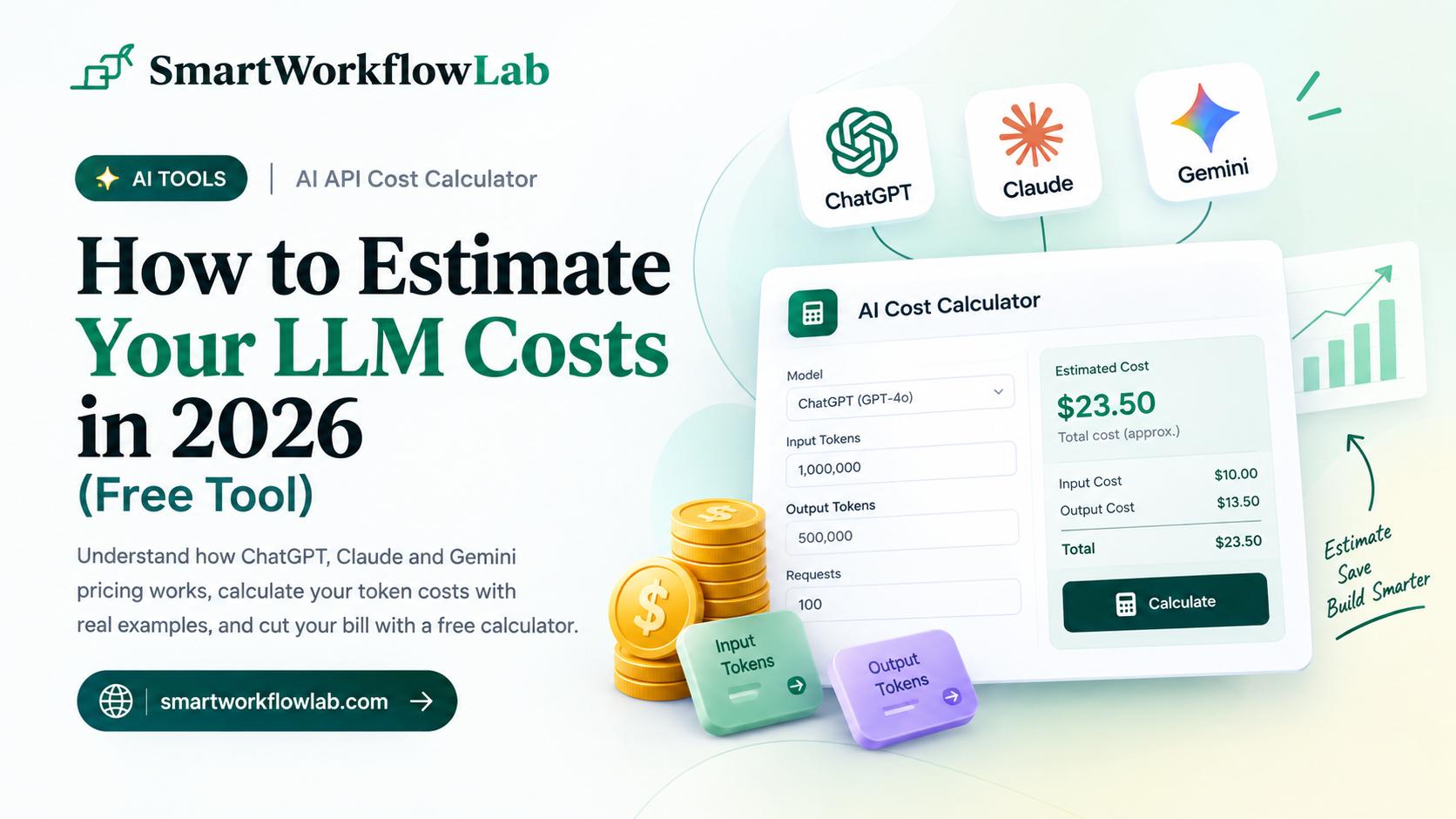
Reading about the math is one thing; seeing your own number is another. Our free AI API cost calculator lets you enter your model, your input and output token estimates, and your request volume, then works out the cost across providers so you can compare before you commit to a build.
It’s the fastest way to answer the real question — what will this cost me per month? — and to test how much you’d save by switching models or shortening outputs.
Watch Out For These
A few costs and quirks that surprise people, so your estimate matches your actual bill.
- Reasoning tokens count as output. Models that “think” before answering generate extra hidden tokens billed at the output rate. Powerful, but pricier than the visible response length suggests.
- Long context can cost extra. Some models raise their rate once a prompt crosses a size threshold, so very long documents may bill at a premium.
- Tool calls and extras have their own fees. Web search, file search, image processing, and embeddings are often billed separately from plain text tokens.
- Tax and regional surcharges apply. Listed rates are usually before tax, and some providers add regional or data-residency multipliers.
- Prices change — plan for it. New models, introductory rates that expire, and periodic adjustments mean today’s number may not be next quarter’s. Estimate against live rates rather than memorized ones.
How SmartWorkflowLab Helps
We test AI tools and build with these APIs in real projects, which means we’ve felt where the costs actually hide — the resent conversation history, the flagship model doing a budget model’s job, the output nobody capped. That hands-on experience is why our guidance focuses on the levers that move your bill, not just the sticker prices.
If you’re planning an AI build and want a realistic cost estimate before you commit, or you’re trying to bring an existing bill down, our calculator and our practical, no-hype approach are built for exactly that.
Frequently Asked Questions
1. How much does the ChatGPT API cost?
You pay per token, not a flat fee. Costs depend on which model you use and how much text goes in and comes out. Budget models run a few cents per million tokens, while flagship models cost several dollars per million. For a rough monthly figure, light personal use often lands around 5 to 40 dollars, and small production apps around 40 to 200 dollars. Always check the live pricing page, since rates change often.
2. What is a token, and why am I billed for it?
A token is a small chunk of text — roughly three-quarters of a word, so 1,000 tokens is about 750 words. AI APIs read and write in tokens, so you are billed for the tokens you send (input) plus the tokens the model generates (output). Output usually costs several times more than input.
3. How do I calculate my AI API cost?
Multiply your input tokens by the model’s input rate, do the same for output tokens with the output rate, then add them and multiply by how many requests you make. Because the math gets fiddly across models and volumes, a calculator is the fastest way — you enter your usage and it does the arithmetic across providers.
4. Which AI API is the cheapest?
Budget models from the major providers are the cheapest, often under a dollar per million input tokens, and are fine for simple, high-volume tasks. The flagship reasoning models cost many times more. The real lever is matching the model to the task rather than defaulting to the most powerful one.
5. Is the ChatGPT API the same as a ChatGPT subscription?
No. The ChatGPT app subscription is a flat monthly fee for a person to chat in the app. The API is the developer service that powers your own app or automation, and it is billed per token based on usage. They are separate products with separate pricing.
6. Why did my AI API bill suddenly go up?
Usually because token usage grew without anyone noticing — longer prompts, more conversation history sent each turn, longer outputs, or simply more users. Reasoning models that generate hidden thinking tokens can also raise output costs. Monitoring usage and estimating before you scale prevents surprise bills.
7. How can I reduce my AI API costs?
The biggest levers are choosing a cheaper model for simple tasks, using prompt caching for repeated context, running non-urgent jobs through a batch mode for a discount, and keeping outputs short. Together these can cut a bill by more than half without hurting quality.
8. Are AI API prices fixed?
No, they change frequently, and providers often run introductory rates or adjust prices as new models launch. That is exactly why estimating with a calculator against current rates, rather than memorizing numbers, is the reliable approach.
Final Thoughts
AI API costs feel mysterious only until you understand the one unit behind them: tokens. Once you know that you’re paying for input and output separately, that the model tier is your biggest cost lever, and that a few optimizations can halve a bill, estimating your spend becomes straightforward instead of scary.
Don’t guess, and don’t rely on a number you read months ago. Work out your real usage, run it against current rates, and see what your project actually costs before you build it. The free calculator does the math for you across ChatGPT, Claude, and Gemini in a few seconds — start there, then use the levers above to bring the number down.
Building something with AI? SmartWorkflowLab tests these tools in real projects and shares honest, practical guidance on getting the most from them without overspending. Explore our other guides, or get in touch if you want help estimating or optimizing your AI costs.