

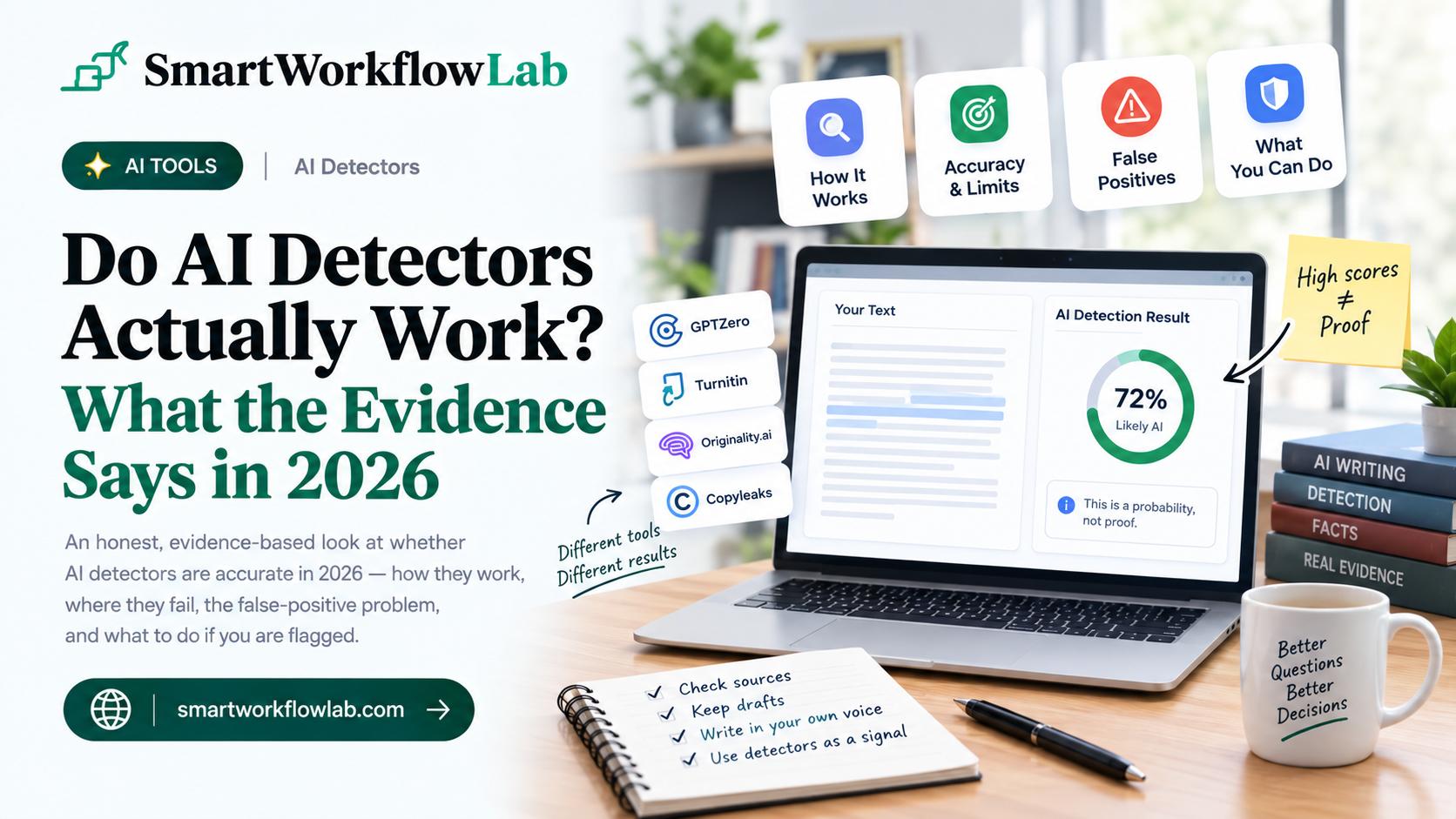
A PhD student writes her thesis introduction over four months. Every word is hers — no AI, no grammar checker, not even spellcheck. Her university’s detection system flags it as 67 percent AI-generated. She spends two weeks rewriting perfectly good sections just to lower a score, and the rewrite comes out worse than the original. Stories like this are exactly why the question “do AI detectors actually work?” matters so much in 2026.
The honest answer is more complicated than either the tools’ marketing or the panic around them suggests. AI detectors aren’t useless — but they’re not the reliable lie-detectors people treat them as, either. Understanding where they work and where they fail is the difference between using them sensibly and doing real harm with them.
This guide breaks down how AI detectors actually work, how accurate they really are, the false-positive problem nobody markets, and what to do whether you’re worried about being flagged or thinking about using one on others.
The Short Answer
AI detectors partly work. On raw, unedited AI output, the good ones are fairly accurate — often catching well above 85 percent in ideal conditions. But that’s not how AI is usually used. On edited, paraphrased, or reworked text, accuracy falls off a cliff, and detectors regularly flag genuine human writing as AI.
The most accurate way to put it: AI detectors are accurate enough to be a signal, never accurate enough to be a verdict. They can raise a question worth asking. They cannot answer it on their own — and treating a score as proof is where people get hurt.
How AI Detectors Actually Work
Detectors don’t “see” AI the way a human might sense something is off. They run statistics, and almost all of them rely on two signals.
The first is perplexity — how predictable the text is. AI language models tend to choose statistically likely next words, which makes their output measurably more predictable than most human writing. Low predictability looks human; high predictability looks like AI.
The second is burstiness — how much sentence length and structure vary. Humans tend to mix long, rambling sentences with short punchy ones. Some AI writing is more uniform. Detectors read that uniformity as a machine fingerprint.
The crucial thing to understand is that this is all probability, not proof. A detector isn’t catching AI red-handed; it’s estimating how closely your text matches patterns it associates with AI. Which is exactly why plain, predictable human writing can look “AI” to a machine — and why the numbers get shaky the moment text is edited.
How Accurate Are They, Really?
The honest picture depends entirely on what kind of text you feed them. Independent testing tells a consistent story across three scenarios.
- Raw, unedited AI output — this is the number in the marketing. In lab conditions, the best detectors catch roughly 85 to 99 percent of straight-from-the-model text.
- Lightly edited AI text — the real-world scenario, since almost nobody pastes raw output. Here accuracy drops to around 55 to 80 percent.
- Heavily reworked or “humanized” text — most detectors fall below 40 percent, meaning they miss more than they catch.
So the impressive accuracy claims are real, but only for a scenario that barely exists in practice. The way AI actually gets used — as a draft that a human edits — sits squarely in the zone where detectors are least reliable. And that’s before we get to their biggest problem.
The Real Problem: False Positives
A detector missing some AI text is one thing. A detector accusing a real person of cheating is far worse — and it happens more than the tools admit.
Reported false-positive rates range from a reasonable few percent to an alarming third or more, depending on the tool. Even at a “good” 2 to 3 percent, that’s roughly 1 in 50 genuine human documents wrongly flagged. Run enough essays or reports through a detector and false accusations are a mathematical certainty, not a rare glitch.
Worse, the errors aren’t random — they’re biased. The single most important fairness finding about AI detectors is their bias against non-native English speakers. A widely cited Stanford study found detectors flagged more than half of essays written by non-native English speakers as AI-generated, while correctly clearing almost all essays by native speakers. Plain, simple, or formulaic human writing — exactly the style many careful or non-native writers produce — is the most likely to be wrongly flagged.
The human cost is real: the honest student rewriting their own work to please a machine, the writer accused over an article they labored over. That risk is why no serious source treats a detector score as evidence on its own.
Why Detectors Disagree With Each Other
If you’ve run the same text through several detectors and gotten wildly different scores, you’ve seen the problem firsthand. There are two main reasons.
First, they chase a moving target. Detectors are trained on the output of specific AI models. When a new model launches, text written by it can look different enough that older detectors fail — unless the tool retrains quickly. The best tools update within days of a major model release; the worst haven’t updated in a year and will still hand you a confident score.
Second, short text can’t be judged reliably. Detection is statistical, and a 50-word paragraph simply doesn’t contain enough data to establish a pattern. Most tools are far less reliable on anything under a few hundred words, which is why short answers and blurbs produce especially noisy results.
The takeaway: when detectors disagree, that disagreement is the honest signal — it’s telling you none of them is certain.
If You’re a Student or Writer Worried About a False Flag
The instinct when you hear about false positives is to ask how to “beat” the detector. That’s the wrong move — gaming detection tools can itself look like an attempt to hide something, and it doesn’t address the real issue. The genuine defense is being able to show your work is yours.
- Write in your own voice. The most human-sounding text is text you actually wrote. If you use AI to brainstorm, rewrite the ideas in your own words rather than pasting output.
- Keep your drafts and version history. Tools that track changes over time — a document’s revision history, for example — show your work developing, which is far stronger evidence of authorship than any detector score.
- If you’re flagged, stay calm and open a conversation. Point to your drafts, and to the well-documented false-positive problem, especially the bias against plain and non-native English writing. A score is a starting point for a discussion, not a conviction.
The goal isn’t to trick a flawed tool. It’s to make sure a flawed tool can’t override the truth that the work is yours.
If You’re a Teacher or Employer Thinking of Using One
Detectors can have a place — as a screening signal that prompts a closer human look. They should never be the thing that decides an accusation.
Even the tools’ own makers say this. Turnitin, for instance, has advised institutions not to use detection to make automated decisions, framing a score as the start of a conversation rather than its conclusion. Given the documented false positives and the bias against non-native English writers, acting on a score alone risks punishing innocent people — and disproportionately the ones already at a disadvantage.
The responsible approach: treat a flag as a reason to look more closely and talk, weigh it alongside other evidence like drafts and the person’s known writing, and never present a probability as proof. If you wouldn’t accept “the software said so” as evidence in any other serious matter, don’t accept it here.
The Honest Bottom Line
Do AI detectors actually work? They work as an imperfect signal on certain kinds of text, and they fail — sometimes badly — on the messy, edited, real-world writing that dominates 2026. Their headline accuracy is real but narrow; their false positives are real and unfair; and their confidence often outruns their reliability.
Used as one input among several, with human judgment on top, they can be part of a sensible process. Used as a verdict, they cause exactly the kind of harm the PhD student at the start of this article lived through. The technology isn’t the villain — treating a probability as proof is.
How SmartWorkflowLab Helps
We test AI tools honestly, including the ones that claim to catch AI, which means we care as much about where a tool fails as where it shines. On detection specifically, the useful guidance isn’t a ranking of “best detectors” — it’s understanding what any of them can and can’t legitimately tell you.
If you’re navigating AI use and detection in your work or organization — setting a fair policy, or figuring out how much to trust a flag — that’s exactly the kind of practical, no-hype question we’re glad to help think through.
Frequently Asked Questions
1. Do AI detectors actually work in 2026?
Partly. On raw, unedited AI output they are fairly accurate, often catching 85 to 99 percent in ideal conditions. But accuracy drops sharply on edited or paraphrased text, and false positives — flagging genuine human writing as AI — remain a real problem. They are useful as a signal, never reliable enough to be treated as proof.
2. How accurate are AI detectors?
It depends heavily on the text. On raw AI output, the best tools reach roughly 85 to 99 percent in lab conditions. On lightly edited AI text, that falls to around 55 to 80 percent. On heavily reworked or humanized text, most drop below 40 percent. Reported false-positive rates range from a few percent to over a third, depending on the tool.
3. Can AI detectors be wrong about human writing?
Yes, and this is their biggest weakness. Detectors regularly flag genuine human writing as AI, especially plain, formulaic, or academic text. A well-known Stanford study found detectors flagged more than half of essays by non-native English speakers as AI-generated while clearing nearly all native-speaker essays.
4. Why do different AI detectors give different results?
Because they analyze statistical patterns and are trained on different data. A detector trained mainly on older AI models can fail on text from newer ones, and short passages give too little data to judge reliably. Running the same text through several detectors often produces conflicting scores, which is itself a sign of their limits.
5. Can AI detectors be fooled?
Yes. Paraphrasing, editing, or running text through a rewriting tool sharply lowers detection rates, with most detectors dropping below 40 percent on heavily reworked text. This is one reason they cannot be treated as definitive evidence — the same limitation that produces false negatives also makes them unfair as proof.
6. What should I do if I am wrongly flagged as using AI?
Keep evidence of your process — draft history, version tracking, and notes — since these show your work developing over time. Write in your own voice, and if you are flagged, raise it calmly with the instructor or reviewer, pointing to your drafts and to the documented false-positive problem. A detector score is a starting point for a conversation, not a verdict.
7. Should teachers or employers rely on AI detectors?
Not as the final word. Even the tools’ own makers advise using scores as a signal for human review, not as automated proof. Given documented false positives and bias against non-native English writers, a flag should open a fair conversation and be weighed with other evidence, never used to make an accusation on its own.
8. Are AI detectors improving?
They are, slowly, but so are the AI models they try to catch, so it is a moving target. The best tools retrain quickly after new models launch, while weaker ones fall behind and still return confident scores. Improvement does not change the core rule — treat any result as a probability, not proof.
Final Thoughts
The most useful way to think about AI detectors in 2026 is as smoke alarms that sometimes go off when you make toast. They can flag something worth checking, but they’re wrong often enough — and unfairly enough — that acting on the alarm alone is a mistake. The number they give you is a probability wearing the costume of a fact.
If you write, protect yourself by keeping proof of your own process rather than trying to outwit a flawed tool. If you evaluate others, treat a flag as a reason to look closer and talk, never as a conclusion. Either way, the rule is the same: a detector score starts a conversation. It should never end one.
Navigating AI honestly? SmartWorkflowLab tests AI tools and shares straight, evidence-based verdicts without the hype. Explore our other guides, or get in touch if you want help thinking through AI use and policy in your work.