

Introduction
Every piece of AI-assisted content runs through the same invisible risk: the model doesn’t know when it’s wrong. A hallucinated statistic reads exactly like a real one — same confident tone, same clean sentence structure, same total absence of a raised hand saying “actually, I’m not sure about this.”
That’s what makes fact-checking AI-generated content a different job than fact-checking a human draft. A human writer who’s unsure tends to hedge, leave a placeholder, or flag it for someone else. A language model just fills the gap with something plausible and moves on. If you’re publishing AI-assisted content — a blog, a product page, client work, anything with your name or your company’s name attached — you need a process built around that specific failure mode.
This guide breaks down what fact-checking AI content actually involves, why it matters, how the verification process works step by step, and how to build it into a team’s publishing workflow without slowing everything to a crawl. If your team is publishing AI-assisted content regularly, this is the process to have in place before the next piece goes live.
Table of Contents
- What Is Fact-Checking AI-Generated Content?
- Why Businesses Need to Fact-Check AI Content
- How the Fact-Checking Process Works
- AI Detection vs. AI Fact-Checking
- How AI Hallucinations Actually Show Up in Text
- Benefits of a Fact-Checking Workflow
- Real Examples by Industry
- Implementation Roadmap
- Best Practices
- Common Mistakes to Avoid
- The Cost of Skipping Fact-Checking
- Future Trends in AI Content Verification
- Frequently Asked Questions
- Conclusion
What Is Fact-Checking AI-Generated Content?
Fact-checking AI-generated content is the practice of verifying every checkable claim in an AI-assisted draft — statistics, quotes, citations, names, dates — against a real, traceable source before it gets published.
The word “checkable” is doing real work in that definition. You’re not fact-checking whether the writing is good, whether the tone fits your brand, or whether the argument is persuasive. You’re specifically confirming that anything presented as a fact actually is one, and that it’s presented accurately rather than paraphrased into something subtly wrong.
Think of fact-checking as the layer that sits between “the AI produced a plausible-sounding draft” and “this is safe to put your name on.”
Why Businesses Need to Fact-Check AI Content
Three incidents from the last few years show what happens when this step gets skipped.
In January 2023, CNET was found to be quietly publishing dozens of AI-written personal finance explainers under a “CNET Money Staff” byline. Once readers and reporters started digging, the outlet ended up issuing corrections on 41 of the 77 AI-assisted articles it had published. One piece on compound interest got the actual math wrong — the kind of error that’s easy to miss if you’re skimming for tone and hard to miss if you actually check the arithmetic. CNET paused the program and rewrote its AI policy afterward.
Later that same year, Sports Illustrated’s publisher came under fire after a report found the site had run product-review articles under the names of writers who didn’t appear to exist anywhere online — complete with headshots traced back to an AI face-generation marketplace. The publisher blamed a contracted vendor and pulled the content, but the damage to trust was already done, and it cost the CEO his job within weeks.
And in one of the most widely cited legal cases on this topic, a New York attorney used ChatGPT to research case law for a federal court filing in 2023. The tool invented six court cases from scratch — complete with fake quotes, fake docket numbers, and real judges’ names attached to opinions those judges never wrote. When opposing counsel couldn’t find the cases, the presiding judge asked the attorney to produce them. He couldn’t, because they didn’t exist. He’d even asked ChatGPT directly whether the cases were real, and it told him yes. Both attorneys involved were sanctioned $5,000 and ordered to notify every judge whose name had been fabricated into a fake ruling.
None of these were caused by AI writing badly. The prose was fine in every case. What failed was the missing step where a human traces every claim back to something real before it goes out the door.
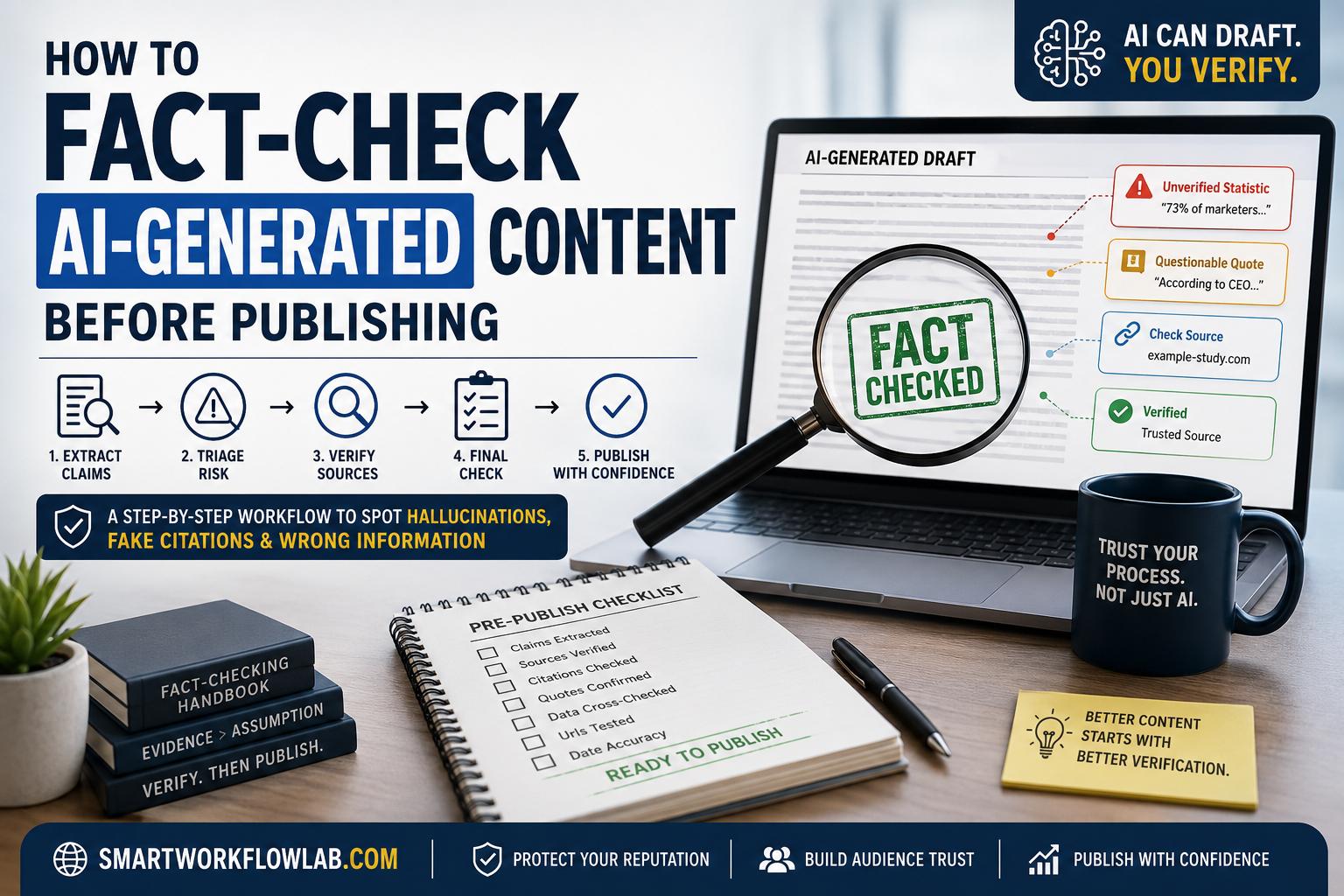
How the Fact-Checking Process Works
A reliable fact-checking pass moves through three stages:
1. Extraction. Read through the draft once and pull out every claim that could, in theory, be proven true or false: numbers, dates, names, direct quotes, “studies show” statements, causal claims, and anything attributed to a source. Leave out pure opinion and framing — you’re not fact-checking whether the AI’s writing style is good, just whether its factual assertions hold up. At scale, list each claim on its own line in a doc or spreadsheet, with a column for the source and a column for verification status.
2. Triage. Not every claim deserves the same amount of scrutiny, and treating them all equally is how fact-checking becomes a task nobody has time to finish. Sort claims into three tiers: high risk (statistics, direct quotes, named studies, legal or medical claims, historical dates), medium risk (general trend statements, product comparisons), and low risk (opinions, generic framing). Spend almost all your time on the high-risk tier — that’s where the CNET math error and the fake court cases both lived.
3. Verification. Different claim types need different checks. Statistics need to be traced to their original source, not the AI’s paraphrase. Quotes need to be searched in their exact phrasing to confirm where they actually appeared. Citations need to be confirmed to exist before you worry about what they say. Current-events claims need a freshly dated source, since AI training data has a cutoff. Images or video need reverse search and verification tools of their own.
Nobody had to guess whether a claim was solid. The process already told them.
AI Detection vs. AI Fact-Checking
These two get confused constantly, but they answer completely different questions.
| Aspect | AI Detection | AI Fact-Checking |
|---|---|---|
| Question it answers | Was this text likely written by a language model? | Is what this text claims actually true? |
| Typical tools | Originality.ai, GPTZero, ZeroGPT | Google Scholar, CrossRef, fact-check databases, manual source tracing |
| What a “pass” tells you | Nothing about accuracy | The claims are traceable to real sources |
| Failure mode if confused | Publishing false content that “scores as human” | Assuming AI-flagged content must be inaccurate |
An AI-detection score is not a fact-check, and treating it as one is one of the more common mistakes content teams make. Content can score 100% human-written and still contain a fabricated statistic. Content flagged as AI-written can be completely accurate. Detection and verification are two separate steps, and skipping the second because the first came back clean is exactly how errors slip through.
How AI Hallucinations Actually Show Up in Text
Most advice on spotting AI content focuses on images — warped hands, garbled text on signs, that uncanny plastic-skin look. That’s a different problem from fact-checking a written draft. Text hallucinations look completely different, and they’re harder to catch because nothing looks wrong.
| Hallucination Type | What It Looks Like |
|---|---|
| Fabricated citations | A study, report, or case that sounds exactly like something that should exist — and doesn’t |
| Invented statistics | A precise-sounding number (“73.4% of marketers say…”) with no traceable original source |
| Misattributed quotes | Real-sounding words placed in a real person’s mouth, or attached to the wrong person entirely |
| Conflated entities | Two similarly named companies, studies, or people merged into one, with details bleeding together |
| Stale “current” information | An answer that was true at the model’s training cutoff but isn’t true anymore |
| Dead or non-resolving URLs | A link that follows the right pattern for a real domain but goes nowhere |
None of these announce themselves. They read exactly like the true sentence next to them, which is why “does this sound right” is not a fact-checking method.
Benefits of a Fact-Checking Workflow
Building fact-checking into your content process pays off in a few concrete ways:
- Protects reputation and reader trust, which is far more expensive to rebuild than to maintain in the first place.
- Reduces legal and liability exposure, particularly for content touching financial, medical, or legal claims.
- Catches errors before they’re public, replacing reactive corrections with a proactive check that costs minutes instead of a credibility hit.
- Builds long-term content credibility, since publications known for accuracy tend to earn more trust from both readers and the sources they cite.
- Scales better than ad-hoc review, because a documented process doesn’t depend on any one editor happening to notice a problem.
Real Examples by Industry
Media and publishing. CNET’s AI-written finance articles and Sports Illustrated’s AI-generated author profiles both show the same pattern: content that looked polished enough to publish without anyone tracing the underlying claims or author identities back to something real.
Legal. The ChatGPT court-filing case is the clearest example of fact-checking failure with real consequences — an attorney trusted the tool’s own confirmation that its citations were real, instead of checking a legal database directly.
Marketing and PR. Outside of these named incidents, the same risk applies whenever AI drafts client-facing content: a fabricated statistic in a press release or a misattributed quote in a blog post carries real reputational risk even without a public scandal attached, since the person or brand whose name is on the piece is the one accountable for it.
Implementation Roadmap
- Pick a pilot content type, not your entire publishing pipeline — a single blog category or content format is enough to start.
- Build a claim-extraction habit for that content type: pull out every checkable claim before anything else happens to the draft.
- Set triage rules specific to your content — what counts as high risk for a finance blog differs from what counts as high risk for a product review.
- Choose verification tools for each claim type your content typically includes (statistics, quotes, citations, current-events claims).
- Assign an owner for fact-checking sign-off — writer, editor, or a dedicated reviewer — so it doesn’t depend on whoever happens to notice something.
- Document a short pre-publish checklist and build it into whatever step comes right before “publish” in your workflow.
- Review and adjust after the first few weeks, since real drafts will surface claim types your initial triage rules didn’t anticipate.
- Expand to additional content types once the process is running smoothly for the pilot category.
Best Practices
- Triage claims by risk before verifying anything — don’t spend equal time on a statistic and a stylistic opinion.
- Trace statistics to their original source, not the AI’s paraphrase of it.
- Confirm a citation exists before evaluating what it says.
- Treat any “current” or “latest” claim as unverified until checked against a freshly dated source.
- Use a second model to challenge specific claims rather than asking the same model to confirm its own work.
- Keep the checklist short enough that people will actually use it every time.
Common Mistakes to Avoid
Trusting the AI’s own confirmation. Asking a model whether its own claim is accurate isn’t verification — it’s exactly what happened in the ChatGPT court-filing case, where the tool confidently confirmed its own fabricated cases were real.
Treating an AI-detection score as a fact-check. A “human-written” score says nothing about whether the content is true, and a “likely AI-written” flag says nothing about whether it’s false.
Verifying everything with equal effort. Without triage, fact-checking becomes a task nobody has time to finish, and the highest-risk claims get the same rushed glance as the lowest-risk ones.
Skipping verification because the writing sounds confident. Confident tone is not a signal of accuracy — it’s the default output style of the model, whether the underlying claim is real or invented.
No designated owner. If fact-checking isn’t explicitly assigned to someone, it tends to become everyone’s job and therefore no one’s.
The Cost of Skipping Fact-Checking
| Scenario | Without Fact-Checking | With Fact-Checking |
|---|---|---|
| Fabricated statistic in a published piece | Discovered by a reader or competitor, often publicly | Caught before publish, no correction needed |
| Misattributed quote | Risk of a complaint from the person misquoted | Verified against original context before it runs |
| Fabricated citation in high-stakes content (legal, medical, financial) | Real risk of sanctions, liability, or reader harm | Confirmed to exist and checked against what it actually says |
| Reader trust | Erodes with each visible correction | Builds over time with a track record of accuracy |
The pattern across CNET, Sports Illustrated, and the ChatGPT court filing is the same: the cost of catching an error before publishing is a few minutes of verification. The cost of catching it after is a public correction, a damaged reputation, or in the legal case, a formal sanction.
Future Trends in AI Content Verification
- Content provenance and watermarking standards maturing to the point where a piece’s editing and sourcing history can be checked more directly, not just inferred.
- Adversarial, multi-model verification becoming a more standard step, where a second model is used specifically to challenge claims in a draft rather than confirm them.
- AI editorial policies becoming a baseline expectation for publications and content teams, similar to how style guides became standard well before AI existed.
- Disclosure norms continuing to firm up across journalism, PR, and marketing, as industry bodies and regulators weigh in on when AI involvement needs to be stated.
- Fact-checking tools built specifically for AI output, rather than general-purpose fact-checking databases, becoming more common as the volume of AI-assisted content grows.
None of this replaces the fundamentals covered in this guide. The teams getting the most value from newer tools are usually the ones that already have a documented claim-extraction and triage habit to build on.
Frequently Asked Questions
Can AI fact-check its own content? Not reliably on its own. The same model that hallucinated a fact will often confidently confirm that fact when asked — that’s precisely what happened when the attorney in the ChatGPT court case asked the tool to verify its own fake citations. A second, independent model or a human check catches far more than asking the original source to grade its own work.
What’s the fastest way to fact-check AI content at scale? Triage. Don’t try to verify every sentence with equal rigor — pull out the high-risk claims (stats, quotes, studies, legal/medical/financial statements) and put your time there. Low-risk opinion and framing doesn’t need the same scrutiny.
Are AI detectors the same as fact-checkers? No, and conflating the two is a common mistake. An AI detector estimates whether text was likely written by a language model. It says nothing about whether the content is accurate. Perfectly human-written content can be false, and AI-flagged content can be entirely correct.
Do I need to disclose AI use if I’ve fact-checked it? Norms here are still settling, and they vary by industry — journalism, PR, and academia each have different standards. As a general practice, disclosure matters most when AI use could affect how much a reader trusts the source of the information (a quote, a byline, expert commentary) rather than when it’s used as a drafting or research aid on content you’ve fully verified yourself. When in doubt, check your organization’s editorial policy or your industry’s ethics guidelines rather than defaulting to either extreme.
How long does it take to build a fact-checking process into a content workflow? A basic claim-extraction and triage habit can be adopted almost immediately by an individual writer. Building it into a full team workflow — with a designated owner and a documented checklist — typically takes a few weeks of iteration to fit how your team actually publishes.
Does fact-checking slow down content production? It adds time, but far less than a public correction does. Triaging by risk level, rather than verifying every sentence equally, keeps the added time proportional to how much is actually at stake in the piece.
Conclusion
Fact-checking AI-generated content isn’t about distrusting the tool — it’s about removing the one step AI genuinely can’t do for you: confirming that what it wrote is actually true. The teams that get this right aren’t re-verifying every sentence with equal effort. They’re triaging claims by risk, tracing the high-stakes ones back to a real source, and building that habit into their workflow before anything goes live.
If you’re weighing how to put a fact-checking process in place for your content team, [Your Site] can help you build a claim-extraction workflow, choose the right verification tools, and set up a pre-publish checklist that fits how your team actually works. Reach out to [Your Site] to talk through your content workflow and see where a fact-checking process would make the biggest difference for your team.
Suggested image alt text: “Editor fact-checking an AI-generated draft against source material before publishing” Suggested image title: “How to Fact-Check AI-Generated Content Before Publishing 2026” Suggested image caption: “A claim-by-claim workflow for verifying AI-generated content before it goes live.”