

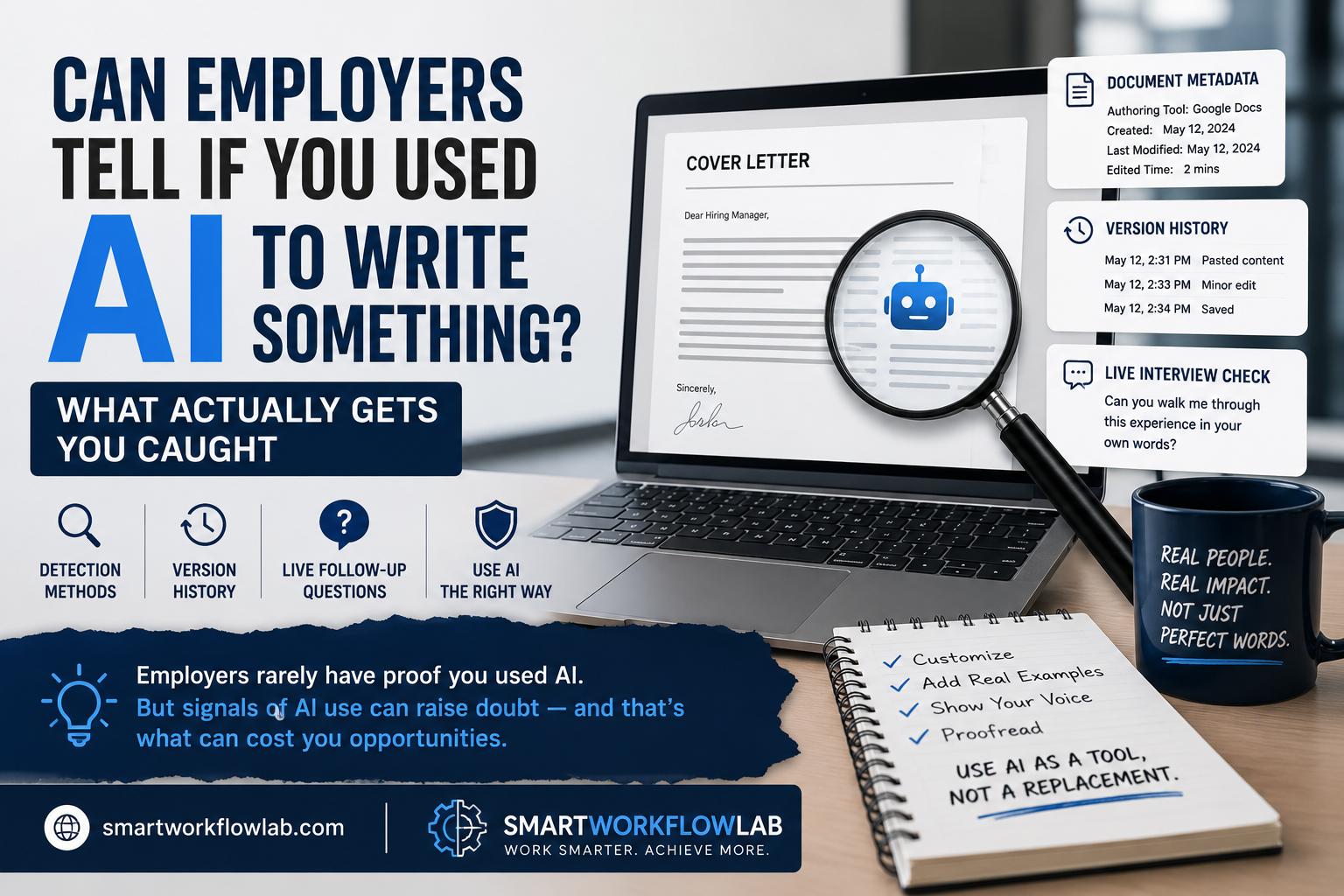
Can employers tell if you used AI to write something? Most of the time, not with certainty — but a lot of them can tell something’s off, and “something’s off” is usually enough to cost you a callback.
Proving AI use and suspecting it are two different problems. Proving it requires evidence — metadata, a paper trail, an admission. Suspecting it just requires reading your cover letter and feeling like nobody actually wrote it. The second one happens constantly. The first one barely happens at all.
This guide covers what actually triggers that suspicion, what tools and methods employers really use, and — importantly — what happens after the hiring stage, once you’re actually on the job. It’s written for job seekers and employees who want a straight answer, not a detector-marketing pitch.
The Short Answer
Most employers can’t prove you used AI to write your resume, cover letter, or a work document. What they can do is notice patterns that make them suspect it, and that suspicion alone often does the damage — no proof required, because a quiet pass on your application doesn’t need a stated reason.
| Question | Answer |
|---|---|
| Can an employer prove you used AI? | Rarely. There’s no reliable way to confirm authorship after the fact. |
| Can they suspect it? | Constantly. Generic phrasing, mismatched tone, and vague claims all raise flags. |
| Do AI detectors work? | Inconsistently. They flag human writing as AI and miss AI writing that’s been edited. |
| Does it actually matter if you used AI? | Less than people think — what matters is whether the content is true and specific. |
How Employers Actually Detect AI Writing
Most advice on this topic stops at “it sounds robotic.” True, but not that useful — you already knew that. Here’s what actually happens mechanically, from the obvious signals to the ones almost nobody talks about.
Generic phrasing is the baseline tell. Buzzwords without evidence — “results-driven,” “passionate team player” — read as filler because they carry no proof. A cover letter that never names the company or references anything specific about the role looks like it could’ve been sent to fifty other companies, because it probably was. Real, but well-covered ground.
Document metadata and version history give people away. If you write a cover letter in Google Docs and paste in an AI-generated draft as one block, the revision history shows exactly that — a large chunk of text appearing all at once, followed by a few small edits. A document someone actually wrote looks different in that history: sentences built up over time, backspacing, paragraphs rearranged. Some hiring managers, especially for writing-heavy roles, now ask candidates to share a document’s edit history or submit a Google Doc link instead of a PDF specifically because of this.
Cross-document voice mismatch is an underrated signal. A recruiter reading your cover letter usually also has your resume and LinkedIn profile open. If your cover letter is smooth and formal but your LinkedIn “About” section reads like a normal person talking — or vice versa — that inconsistency is hard to explain away. People don’t usually have two writing voices. AI-assisted documents often do.
AI detection software gets used, but it’s unreliable. Tools like GPTZero, Originality.ai, and Copyleaks estimate a probability based on sentence patterns, not a confirmed fact. Independent testing has shown false-positive rates ranging from roughly 10% to over 50%, depending on the tool and the writing style being analyzed — formal, structured human writing gets flagged constantly. Accuracy also drops sharply once AI text has been edited by a person, which is how most people actually use these tools.
The live follow-up question catches more people than any detector. A hiring manager reads your cover letter, picks the most specific claim in it, and asks you to expand on it: “You mentioned leading the migration to the new CRM — walk me through how that went.” If you wrote that sentence yourself, you have plenty to say. If AI wrote it from a vague prompt, you’re stuck expanding on something you don’t remember doing, because you didn’t do it, or did it very differently.
Model-specific tics exist, but the popular advice about them is often wrong. Em dashes get blamed constantly, unreliably — plenty of people who’ve written that way for years now get side-eyed for it. More useful: ChatGPT tends toward “It’s not just X, it’s Y” constructions and grouping things in threes; Claude tends to hedge more; Gemini defaults to heavy bullet structuring even in prose. None of this proves anything alone, and a careful edit removes all of it in minutes.
What Happens If They Think You Used AI
Three outcomes are possible, and they’re not equally common.
Most of the time, nothing visible happens. You just don’t hear back — application volume alone gives employers cover to go quiet on anyone, so a suspected-AI application disappears into the same silence as an unqualified one.
Less commonly, it comes up directly in an interview, usually phrased gently: “How did you put your application together?” This is becoming a normal, non-accusatory question, since AI use is now the norm rather than the exception.
Rarest is an outright rejection where AI use is stated as the reason, typically reserved for roles where writing itself is the skill being evaluated.
If you’re asked directly, honesty is almost always the safer answer. “I used it to help structure a first draft, then rewrote it with my own examples” is a normal, unremarkable response in 2026. Getting caught in a denial is a worse outcome than the AI use itself.
Does It Matter If You Used AI?
The line that most thoughtful hiring guidance converges on: using AI to express real experience is fine. Using AI to invent experience is the problem.
Anthropic’s own public guidance for candidates draws this distinction explicitly — AI is fine for refining how you communicate real qualifications, but not for creating experience you didn’t have. That standard isn’t about the tool at all. It’s about accuracy.
Using AI for job applications is now the norm, not the exception — Greenhouse’s 2025 hiring research found the majority of job seekers use it in some form. Given that, most recruiters have adjusted expectations rather than treating AI use itself as disqualifying. What still gets people rejected is what always got people rejected: vague claims, no evidence of relevant experience, and cover letters that could be sent to anyone.
Using AI at Work After You’re Hired
Almost everything written about this topic stops at the hiring stage. But using AI for a cover letter and using AI for a team’s quarterly report aren’t the same situation, and they don’t carry the same stakes.
Once you’re employed, detection shifts from “does this feel generic” to something more systematic. Some companies deploy monitoring software tracking which AI tools employees access and how often, often for security or compliance reasons rather than performance policing. Others notice the low-tech way — a manager gets three emails from three team members using the identical phrase “I hope this finds you well, and I wanted to circle back,” and puts it together.
| Context | What Gets Noticed | Typical Consequence |
|---|---|---|
| Job application | Generic phrasing, voice mismatch, vague claims | Silent rejection, rarely a stated reason |
| Live interview | Inability to defend a specific claim | Immediate credibility loss |
| On-the-job work product | Identical phrasing across team members, monitoring software flags | Depends entirely on company AI policy |
The open question is whether using AI on a work product without disclosure counts as a problem at all. The honest answer: it depends entirely on your company’s policy, and most companies genuinely don’t have a clear one yet. If your company has an explicit AI use policy, follow it. If it doesn’t, the safer instinct is to disclose when it’s relevant rather than assume silence is fine.
If You’re Accused of Using AI (Fairly or Not)
Given how unreliable AI detectors actually are, being flagged incorrectly is a real possibility. If it happens, stay factual rather than defensive — you can accurately point out that detection tools have documented false-positive problems, especially with formal or precise writing.
If a manager or recruiter asks directly, answer honestly rather than getting cornered into a denial you can’t back up later. This is a genuinely new area: candidates and employees have started raising disputes over AI-detection-based decisions. Worth knowing this happens, even though this isn’t legal advice and your specific situation may call for different guidance.
How to Use AI for Job Applications Without It Backfiring
Start with real material, not a blank prompt. Don’t ask AI to “write me a cover letter for a marketing coordinator role.” Instead, hand it your actual resume bullets, the job description, and one or two specific things you want to say, and ask it to build a structure around those. Generic input produces generic output — that’s not an AI flaw, it’s just how the tool works.
Replace every vague claim with a specific one. This is the single highest-impact edit you can make.
Weak (unedited AI draft):
“I am excited to apply for the Marketing Coordinator position. With my strong communication skills and passion for digital marketing, I believe I would be a valuable addition to your team.”
Strong (same starting point, personalized):
“I’m applying for the Marketing Coordinator role because your team’s recent shift toward video-first campaigns is exactly the direction I pushed for in my last job. I ran A/B tests across 12 ad variants for a similar audience, and the winning version increased click-through by 22%.”
The first version could go to five hundred companies unchanged. The second one couldn’t have been written by anyone else, because it’s built from something that actually happened.
Read it out loud before you send it. If a sentence would feel strange to say to someone’s face in an interview, it doesn’t belong in the letter.
Make sure your resume and cover letter tell the same story. If your cover letter says you “led” a project and your resume says you “assisted” with it, that inconsistency gets noticed regardless of whether AI was involved.
How We Help
Our team builds resume and cover letter tools designed around your real experience rather than generic templates — you provide the actual details, and the tool helps you structure and tighten them, not invent them. That distinction is exactly what separates an AI-generated cover letter that gets noticed for the wrong reasons from one that doesn’t.
For teams building broader AI-use guidelines for job applicants or employees, this topic usually connects to a wider conversation about workplace AI policy, where several of these questions get formalized into an actual written standard rather than handled case by case.
Frequently Asked Questions
1. Can employers tell if I used ChatGPT specifically?
Not with certainty. They can sometimes recognize generic AI phrasing, but they generally can’t identify which tool you used, and most won’t try.
2. Can ATS software detect AI-written resumes?
No — an Applicant Tracking System is built to parse and match keywords, not to determine authorship. Some employers layer separate AI detection tools on top of their ATS, but that’s a different system entirely, and it’s far less common than people assume.
3. Is using AI for a cover letter considered cheating?
Not on its own. Using AI to organize or improve your writing is closer to using a grammar checker than to misrepresenting yourself. It becomes a problem specifically when it’s used to invent experience or qualifications you don’t actually have.
4. Should I tell an employer I used AI?
You don’t need to volunteer it unprompted. But if you’re asked directly, or if a posting explicitly says not to use AI, be honest. Getting caught in a denial is worse than the AI use itself.
5. Can I get fired for using AI at work?
It depends entirely on your company’s policy, which many companies don’t have yet. If a policy exists, follow it. If it doesn’t, disclosure is the safer default.
6. Do AI detectors actually work?
Inconsistently. They can flag human-written text as AI and miss AI-generated text that’s been edited, with false-positive rates that vary widely by tool and writing style. Treat a detector result as a signal, not proof.
Final Thoughts
Can employers tell if you used AI to write something? Sometimes, and usually not with proof — but the suspicion alone is often enough to cost you a callback, which makes “can they tell” the wrong question to obsess over. The better question is whether what you submitted is accurate, specific, and something you can actually defend out loud.
Start there, and the detection question mostly takes care of itself.
Want a cover letter that sounds like you, not a template? Try our cover letter builder — start from your real resume bullets, not a blank prompt, and get a first draft you can actually defend in an interview.