

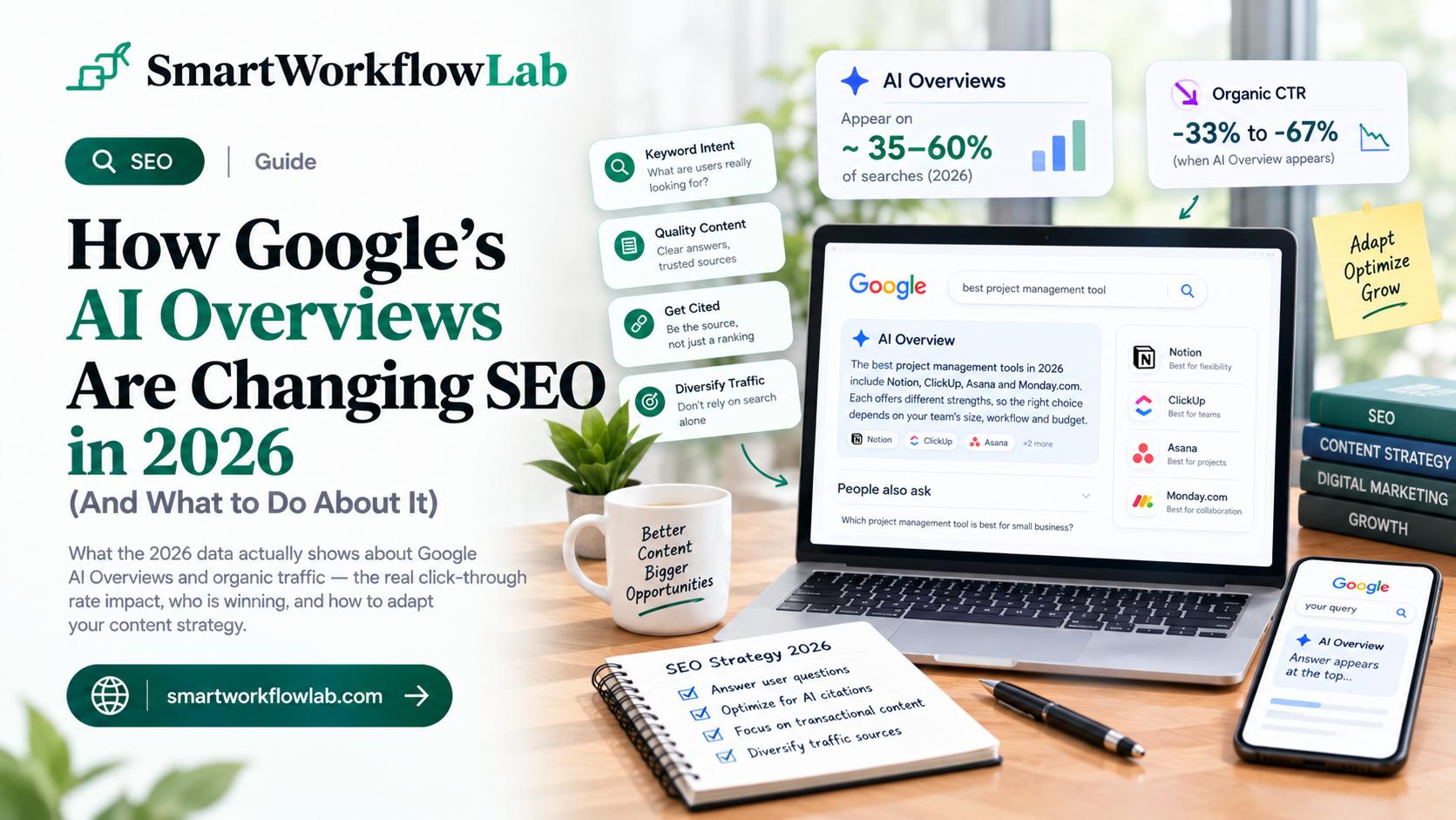
If your organic traffic has quietly slipped over the past year and you can’t find an obvious reason in your rankings, there’s a good chance the reason isn’t your site at all. It’s the box that now sits above your listing on the search results page, answering the question before anyone scrolls down to click you.
Google’s AI Overviews — AI-generated summaries that appear at the top of search results — have gone from an experiment to a fixture of search in under two years. The data on what they’re doing to organic traffic is now substantial, if occasionally messy and inconsistent between studies. What’s not in dispute is the direction: for a large share of searches, fewer people are clicking through to websites than before, and the sites that adapt are pulling ahead of the ones still optimizing for a search landscape that no longer fully exists.
This guide lays out what the 2026 data actually shows, who’s affected most, who’s actually winning, and the practical changes worth making to your content strategy.
The Short Answer
AI Overviews reduce click-through rates on the searches where they appear — that part is consistent across essentially every major study, even though the exact size of the drop varies by report, query type, and position. Broad informational queries take the biggest hit; transactional and navigational searches are much less affected.
The more useful finding for 2026 is this: being cited as a source inside the AI Overview is now associated with more traffic than simply ranking below it. Citation, not just ranking, has become the practical goal. Sites that structure content for clear, direct answers — and that diversify beyond organic search — are holding up far better than sites still optimizing purely for the old rules.
How Common Are AI Overviews Now?
AI Overviews have expanded quickly since their initial rollout, and by 2026 they appear on a substantial share of tracked search queries — estimates from different trackers put the figure anywhere from around a third to over half, with the number still climbing. Growth hasn’t been even: informational and “what is/how does” style queries trigger an AI Overview far more often than transactional or highly specific searches.
Alongside AI Overviews, Google’s separate AI Mode experience goes a step further on some queries, replacing the traditional results list with a conversational interface entirely. For those queries, traditional organic listings may not appear at all unless a site earns a citation within the AI response itself.
What the Click-Through Rate Data Actually Shows
This is where reporting gets messy, because different studies use different methodologies, sample sizes, and time periods — and the numbers move quickly as Google adjusts the feature. Rather than anchor on one headline figure, it’s more useful to look at the pattern across studies.
The consistent finding: when an AI Overview appears on a search result, the click-through rate to traditional organic listings — including the page ranking first — drops substantially compared to the same type of query without one. Reported declines range widely across different research, generally somewhere between roughly a third and two-thirds, depending on the study, the query category, and where in 2025–2026 the data was collected. Some of the most rigorous behavioral research found that users click any traditional organic result only about half as often when an AI Overview is present versus when it isn’t.
There’s also a nuance worth knowing: the steepest declines appear to have happened in late 2025, with some recovery since — but even with that partial rebound, CTR on AI-Overview queries remains meaningfully lower than on queries without one. Read any single “AI Overviews cut CTR by X%” headline with a healthy amount of skepticism about the exact number, while taking the underlying trend seriously.
Not All Content Is Hit the Same Way
The impact is uneven, and understanding where you sit matters more than the average.
Hit hardest: broad informational and definitional queries — “what is,” “how does,” “why does” — where an AI Overview can fully answer the question without sending anyone anywhere. Generic educational content sitting at the top of the funnel is the most exposed category.
Much less affected: transactional queries (buying, booking, signing up), comparison shopping, and navigational searches (finding a specific brand or site). These require an action AI Overviews don’t complete, so users still click through. If your content sits closer to a purchase or specific decision than to a general definition, you’re comparatively insulated.
A meaningful protective factor: brand strength. Sites with strong branded search demand hold up better, since people searching for a company or product by name are looking for that specific destination, not a general answer an AI summary can substitute for.
The Real Opportunity: Getting Cited, Not Just Ranking
Here’s the finding that matters most for what to actually do: across multiple studies, pages that get cited as a source inside an AI Overview see meaningfully more traffic than pages that rank well below the overview but aren’t referenced by it. Being the AI’s source, in other words, now behaves a bit like the new “position one” — arguably more valuable than actually holding position one if your page isn’t the one the AI Overview points to.
That reframes the goal. Instead of optimizing purely to rank, the practical target for at least some of your content becomes optimizing to be the source Google’s AI cites when it answers the query your content covers.
How to Adapt: What Actually Helps
A few concrete shifts, based on what the data suggests is working.
Answer the question directly and early. AI systems extract a clean answer more easily from content that states it plainly near the top than from content that builds up to a conclusion. If a heading implies a question, answer it in the sentence or two right after — before adding nuance and detail.
Use headers that mirror real search phrasing. Structuring content around the actual questions people ask — not generic section titles — makes it easier for both readers and AI systems to find and cite the exact answer.
Back claims with specific, checkable facts. Vague, generic statements are less citable than content with concrete numbers, examples, or named specifics an AI system can lift with confidence.
Use structured FAQ content where genuinely relevant. Content organized as clear question-and-answer pairs — the same pattern search engines already surface as rich results — tends to map well onto how AI Overviews extract and present information.
Lean into what AI Overviews don’t replace. Transactional content, hands-on comparisons, product testing, and anything requiring a judgment call or a specific action is comparatively safe ground. If your site can shift some effort from broad informational posts toward this kind of content, it’s a reasonable hedge.
Diversify beyond organic search. Email lists, direct traffic, communities, and other platforms don’t depend on whether Google decides to answer a query itself. The sites weathering this shift best are rarely the ones relying on organic search alone.
Track citations, not just rankings. Where you can, pay attention to whether your content is being referenced in AI Overviews for your target queries, not only where it ranks in the traditional list below.
Should You Panic?
No. The traffic picture for 2026 is a redistribution, not a collapse — organic search still sends real traffic, and large categories of content (transactional, comparison, brand-specific) are only lightly affected. What’s changed is that a purely informational, top-of-funnel content strategy is a weaker bet than it used to be, and the sites still winning are the ones adjusting what they publish and how they structure it, not the ones publishing exactly as they did in 2023.
The practical takeaway: treat this like any other search algorithm shift — adapt the strategy, diversify where your traffic comes from, and keep shipping content that genuinely answers what people are asking, in a form that’s easy to cite.
How SmartWorkflowLab Helps
We publish and structure our own content with exactly this shift in mind — clear answers up top, genuine FAQ sections, and specifics over vague generalities — because we’re subject to the same search landscape we’re writing about here. That firsthand experience is why our advice on adapting to AI search focuses on concrete structural changes rather than abstract theory.
If you’re trying to figure out how AI Overviews are affecting your specific site, or want help restructuring content to be more citable, that’s exactly the kind of practical question we’re glad to dig into.
Frequently Asked Questions
1. Do AI Overviews really reduce website traffic?
Yes, for most informational content. Multiple 2026 studies show organic click-through rates drop substantially when an AI Overview appears on a search result, since many users get their answer directly on the results page and never click through. The exact drop varies by study and query type, but the direction is consistent across every major report.
2. How much do AI Overviews reduce click-through rates?
Estimates vary by study and methodology, generally showing organic CTR falling somewhere between roughly a third and two-thirds when an AI Overview appears, compared to the same query without one. Some research shows a partial rebound from the steepest declines seen in late 2025, but CTR remains well below pre-AI-Overview levels.
3. What percentage of Google searches now show an AI Overview?
The share has grown quickly through 2025 and into 2026, with multiple trackers reporting AI Overviews appearing on roughly a third to over half of tracked queries, and growth continuing. Coverage varies significantly by topic and industry, with informational queries far more likely to trigger one than transactional searches.
4. Is all website content affected equally by AI Overviews?
No. Broad informational and definitional queries (“what is X”, “how does Y work”) are hit hardest, since AI Overviews answer them directly. Transactional queries (buying, booking, comparing specific products) and navigational queries (finding a specific site) are affected far less, because they require an action AI Overviews don’t complete.
5. What does it mean to get “cited” in an AI Overview?
It means Google’s AI Overview references or links to your specific page as a source for its answer. Multiple studies find that being cited, rather than simply ranking well below the overview, is associated with meaningfully more traffic than pages that rank but aren’t cited — making citation, not just ranking, the new practical goal.
6. How can I optimize content to get cited in AI Overviews?
Answer the implied question directly and early, use clear headers that match real search phrasing, keep answers concise and well-structured, and back claims with specific, checkable facts. Content that requires interpretation to extract an answer is harder for an AI system to cite than content that states the answer plainly.
7. Should I stop doing SEO because of AI Overviews?
No. Traffic from traditional organic search is still substantial, transactional and lower-funnel content is largely unaffected, and getting cited in AI Overviews is itself an SEO-adjacent goal. The smart response is adapting your strategy and diversifying traffic sources, not abandoning search entirely.
8. What should website owners do differently in 2026?
Diversify beyond organic search — email, direct traffic, communities, and other platforms all matter more now. Structure key content for direct-answer citation. Lean into transactional and comparison content, which is less exposed to AI Overviews. And track citations, not just rankings, as a success metric going forward.
Final Thoughts
AI Overviews haven’t ended organic search, but they have changed what “winning” a search result means. Ranking well is no longer the whole game — being the source an AI system trusts enough to cite is quickly becoming just as important, and for some queries, more valuable.
The sites handling this transition well aren’t the ones panicking or abandoning content strategy. They’re the ones structuring their best content for direct, citable answers, leaning into the transactional and hands-on content AI Overviews don’t replace, and making sure organic search isn’t their only way for people to find them. That’s a strategy shift, not a retreat — and it’s the one worth making now, while much of the competition is still optimizing for a search landscape that’s already moved on.
Navigating the shift in search? SmartWorkflowLab tests and structures content with these exact changes in mind, and shares what we learn without the hype. Explore our other guides, or get in touch if you want help thinking through your content strategy for 2026.