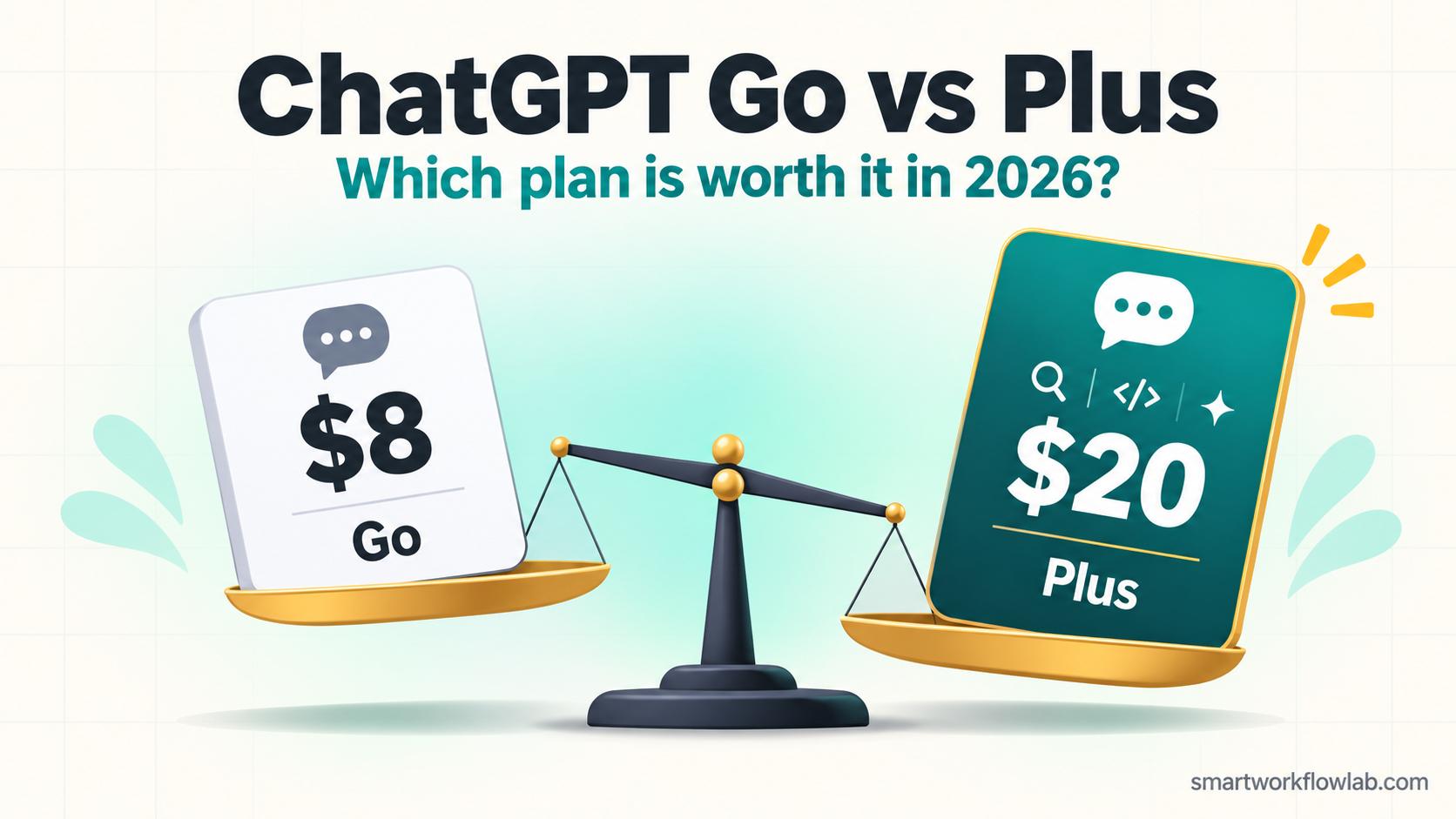
ChatGPT Go at $8 a month is enough if you mainly chat, write and summarise. ChatGPT Plus at $20 is worth the extra $12 if you need the stronger GPT-6 Sol model, deep research, agent mode, Codex for coding or no ads. The biggest difference isn’t the limits: Go runs the same GPT-6 Luna model as the Free plan.
Key differences in one list:
- Model: Go runs GPT-6 Luna; Plus runs GPT-6 Sol.
- Ads: Go may show ads; Plus is ad-free.
- Tools: only Plus gets agent mode, expanded deep research and full Codex.
- Context: the same 54K everyday window (about 40 pages) on both.
- Price: $8 vs $20 a month, both billed monthly only.
How we compared them: This is a research comparison, not a hands-on benchmark. Between November 6 and 7, 2026, we checked OpenAI’s ChatGPT Go launch post, its ChatGPT Go and ChatGPT Plus help articles, and OpenAI’s Codex pricing documentation. For plan-card details such as models, context windows and limits, we used dated independent trackers that read chatgpt.com/pricing, and we name the tracker next to each figure. Where OpenAI publishes no number, we say so. All prices are US dollars unless stated. OpenAI changes plans often, so check chatgpt.com/pricing before you buy. SmartWorkflowLab has no affiliate or sponsorship deal with OpenAI.
What OpenAI doesn’t publish: image limits for any plan, clear voice limits for Go, which model powers Go’s Think button, and how Pro 100 and Pro 500 compare with Plus. We label those figures as user reports or leave them out.
ChatGPT Go vs Plus at a Glance
| Feature | ChatGPT Go | ChatGPT Plus |
|---|---|---|
| Price (US) | $8 a month | $20 a month |
| Price per year | $96 | $240 |
| Chat model | GPT-6 Luna (same as Free) | GPT-6 Sol |
| Thinking | Think button only | Thinking slider: Instant, Medium, High |
| Everyday text chat | Unlimited, within abuse guardrails | Unlimited, within abuse guardrails |
| Instant context window | 54K tokens (about 40 pages) | 54K tokens (about 40 pages) |
| Reasoning context window | 256K tokens | 256K tokens |
| Uploads, images, memory | More than Free | Expanded |
| Deep research | Limited | Expanded |
| Agent mode | ✗ | ✓ |
| Codex (coding agent) | Limited, lightweight tasks | Web, command line, IDE extension and iOS |
| ChatGPT Work | Limited, desktop app only | Desktop, web and mobile |
| Sites and developer mode | ✗ | ✓ |
| Ads | May include ads | No ads |
| Billing | Monthly only | Monthly only |
| Best for | Everyday chat, writing, study | Research, coding, analysis and client work |
The model, context window and feature rows come from OpenAI’s October 7, 2026 GPT-6 rollout and ChatGPT’s pricing page, as reported by Whizi (checked November 1, 2026) and Developers Digest (October 9, 2026).
What Is ChatGPT Go?
ChatGPT Go is OpenAI’s low-cost paid plan, between Free and Plus. It launched in India in August 2025 and rolled out “everywhere ChatGPT is available” on January 16, 2026, at $8 a month in the US, according to OpenAI’s Go announcement. At launch, OpenAI said Go gave “10x more messages, file uploads and image creation than the free tier.” Everyday text chat has since become unlimited on both plans, so today the gap is file uploads, image creation, memory and context: Go holds about 40 pages in a chat against Free’s 12.
What Go doesn’t change is the model. Since the GPT-6 rollout on October 7 and 8, 2026, Free and Go both use GPT-6 Luna for chat. So Go is best understood as a capacity plan: you get more of the Free experience, not a smarter assistant.
What Is ChatGPT Plus?
ChatGPT Plus is OpenAI’s main individual plan at $20 a month, according to OpenAI’s help center. Plus runs GPT-6 Sol in chat with a thinking slider, and adds the tools Go leaves out: expanded deep research, agent mode, full Codex, ChatGPT Work on the web and mobile, Sites and developer mode. It has no ads.
Price: $8 vs $20
The gap is $12 a month, or $144 a year.
| Plan | Monthly | Per year | Notes |
|---|---|---|---|
| Free | $0 | $0 | GPT-6 Luna, may show ads |
| Go | $8 | $96 | GPT-6 Luna, may show ads |
| Plus | $20 | $240 | GPT-6 Sol, no ads |
| Pro | $100, $200 or $500 | $1,200+ | More usage, bigger context |
| Business | $20/user yearly, $25 monthly | $480+ | Teams of 2 or more |
A few pricing details matter:
- Local prices vary. OpenAI says Go “pricing is localized in some markets.” In Canada, Go costs CA$11 and Plus CA$25, according to Whizi, checked November 1, 2026, but other trackers found no Canadian prices on OpenAI’s own pages, so confirm the price at checkout. Where there’s no local price, you pay in US dollars.
- Go can’t be paid yearly. According to OpenAI’s ChatGPT Go help article, Go doesn’t support annual billing or prepaying for several months.
- Plus is monthly only too, with no annual discount, according to CloudZero and Whizi.
- Pro prices come from OpenAI’s Pro tiers help article. Business has cost $20 a seat a month billed yearly, or $25 monthly, with a two-seat minimum, since OpenAI cut seat prices on April 2, 2026, according to CloudZero. We also checked both against OpenAI’s Codex pricing documentation on November 6, 2026.
Models: GPT-6 Luna vs GPT-6 Sol
This is the difference you’ll notice most.
- Go uses GPT-6 Luna, OpenAI’s fast, low-cost GPT-6 model and the same one Free users get. Go has a Think button for harder questions but no Medium or High settings. OpenAI’s pages haven’t clearly said which model powers Think since the GPT-6 switch.
- Plus uses GPT-6 Sol, the stronger model, with a slider for Instant, Medium and High thinking. In ChatGPT Work and Codex, Plus also gets GPT-6.1 Sol, which OpenAI launched on September 29, 2026 and says delivers “nearly the same level of intelligence as GPT-6 Astra” for agentic coding and professional work, according to TechCrunch.
The API prices show the gap between the two models: GPT-6 Luna costs $0.10 per million input tokens and $0.50 per million output tokens, while GPT-6 Sol costs $2 and $10, according to Whizi’s November 1 check of OpenAI’s API price list. That’s 20 times the price, which is why OpenAI keeps Sol for paying Plus users.
What it means in practice: for quick answers, emails, summaries and study help, Luna is good enough and fast. For long documents, multi-step reasoning, tricky analysis or code, Sol with High thinking is noticeably more reliable. If your work depends on getting the hard answers right, the model alone justifies Plus.
ChatGPT Go Limits vs Plus and Free
OpenAI publishes few hard numbers. Here’s what is known, with the source for each figure.
| Limit | Free | Go | Plus |
|---|---|---|---|
| Everyday text chat | Unlimited | Unlimited | Unlimited |
| Instant context | 27K (12 pages) | 54K (40 pages) | 54K (40 pages) |
| Reasoning context | Varies | 256K | 256K |
| File uploads | 3 a day | 80 per 3 hours | 80 per 3 hours |
| Images (user reports) | ~2–3 a day | ~24 a day | ~40–50 per 3 hours |
| Deep research | Limited | Limited | Expanded |
| Codex | Limited | Light tasks | Expanded |
| ChatGPT Work | Desktop only | Desktop only | Desktop, web, mobile |
| Scheduled tasks | ✗ | ✓ | ✓ |
| Memory | Limited | Longer | Expanded |
Where the figures come from: the chat, context window, deep research and memory rows are from ChatGPT’s pricing page and the file upload limits from OpenAI’s file uploads FAQ, as reported in Whizi’s Go limits guide, compiled October 18, 2026. Codex is from OpenAI’s Codex documentation. Image counts are user reports collected by The AI Career Lab, last reviewed October 31, 2026, not OpenAI figures.
Three things stand out:
- Go and Plus have the same context window for everyday chat. If you paste long documents in, Go handles about 40 pages, the same as Plus. Free handles about 12.
- Image limits are user reports. OpenAI doesn’t publish image counts for any plan. The numbers above are what users have observed and can change with demand.
- Voice limits are unclear. OpenAI’s pricing page lists expanded voice for Go, while its Go help article says voice has the same limits as Free, according to Whizi. Expect Go’s voice mode to feel close to Free’s.
Does ChatGPT Go Have Ads?
When OpenAI launched Go worldwide, it said it would test ads “in the free tier and ChatGPT Go” and that “ChatGPT Plus, Pro, Business and Enterprise will remain ad-free,” according to its Go announcement. Go’s pricing card now says “This plan may include ads.”
Ads have spread quickly since the US test began on February 9, 2026. On October 21, 2026, OpenAI expanded ChatGPT ads to 26 more countries, for 89 in total, including Pakistan, Nigeria and Bangladesh, according to Sirapays, which cites OpenAI’s announcement and its ads help article.
How ads work on Free and Go, according to that summary of OpenAI’s ads help article:
- An ad appears as one labelled unit below an answer when a sponsor matches the topic.
- Ads don’t appear near sensitive topics such as health, mental health or politics.
- Temporary Chats never show ads, and OpenAI says it doesn’t show ads to users it identifies as under 18.
- You can turn off ad personalisation, so ads only reflect the current chat.
If ads are a deal-breaker, Go isn’t your plan. Plus is the cheapest ad-free paid option.
What Plus Gets That Go Doesn’t
- GPT-6 Sol in chat, with Medium and High thinking.
- GPT-6.1 Sol and GPT-6 Astra inside ChatGPT Work and Codex.
- Expanded deep research, for multi-source reports with citations.
- Agent mode, where ChatGPT completes tasks in a browser for you.
- Full Codex, on the web, in the command line, in the IDE extension and on iOS. OpenAI estimates Plus covers 15 to 160 GPT-6.1 Sol messages or 350 to 3,000 GPT-6 Luna messages every five hours, and calls these estimates, not fixed limits.
- ChatGPT Work on the web and mobile, not just the desktop app.
- Sites and developer mode.
- Access to legacy models, which Go doesn’t include, according to OpenAI’s Go help article.
- No ads.
If you code, we compare Plus with dedicated coding tools in Cursor Pro vs ChatGPT Plus and Codex vs Claude Code.
ChatGPT Go vs Free: Is Go Worth $8?
Go is worth it if the Free plan’s caps are what’s stopping you, not the quality of the answers. Upgrade to Go if you:
- Upload files most days, since Free allows 3 a day and Go about 80 every 3 hours.
- Paste in long documents, since Go’s 54K window holds about 40 pages against Free’s 12.
- Want ChatGPT to remember more about you and your projects.
- Make images regularly.
- Want scheduled tasks, such as a daily summary.
Stay on Free if you mainly ask short questions. You get the same GPT-6 Luna model, unlimited everyday chat and some deep research and Codex at no cost.
ChatGPT Plus vs Pro: Is the $200 Plan Worth It?
For almost everyone, no. Pro comes in three monthly tiers, Pro 100 at $100, Pro 200 at $200 and Pro 500 at $500, and each includes more usage than the one below, according to OpenAI’s Pro tiers help article. OpenAI doesn’t publish how Pro 100 compares with Plus.
The $200 tier changed at OpenAI’s DevDay on September 29, 2026. From October 30, Pro 200’s included usage in ChatGPT Work and Codex fell from 20 times the Plus allowance to 10 times, and its GPT-6 Pro chat messages from 200 to 100 a week, according to The Next Web. OpenAI’s help article confirms that new Pro 200 subscribers get a lower allowance and that subscribers from September 22 to 29 kept the old one only until October 29. Only Pro 500 includes Ultrafast versions of GPT-6 Astra and GPT-6.1 Sol. Pro also raises the context window to 128K tokens for Instant chat and 400K for reasoning, against Plus’s 54K and 256K, according to Developers Digest.
Pro makes sense only if you hit Plus limits every week on deep research, Codex or long reasoning tasks, and the time you lose waiting for resets costs more than the extra $80 to $480. Start on Plus and upgrade only when limits actually block you.
Which Should You Choose?
| If you’re a… | Choose | Why |
|---|---|---|
| Student on a budget | Go | More uploads and memory, at $8 |
| Writer drafting daily | Go | Luna handles drafts and long pieces |
| Freelancer, client work | Plus | Sol reasoning, no ads, research |
| Small business owner | Plus | Agent mode and deep research |
| Developer | Plus | Full Codex with GPT-6.1 Sol |
| Researcher or analyst | Plus | Deep research, High thinking |
| Quick questions only | Free | Same model as Go, free |
Choose ChatGPT Go if you use ChatGPT every day for writing, study or summaries, keep running into Free’s upload or memory limits, and don’t mind ads.
Choose ChatGPT Plus if you rely on ChatGPT for work where the answer has to be right, you code, you need deep research or agent mode, or you want it ad-free.
A cheap way to decide: pay for Go for a month. If you keep wishing for better answers on hard questions, that’s the GPT-6 Sol gap, and Plus is worth it. To see what a year of AI subscriptions costs your business, try our AI cost calculator.
Switching Between Go and Plus
- Plus to Go: you keep Plus until your billing period ends, then Go starts. There’s no refund for the unused part, according to OpenAI’s Go help article.
- Go to Plus: you can upgrade at any time from your account settings.
- Refunds: Plus fees are non-refundable, except within 14 days of purchase for users in the EU, UK and Turkey, according to OpenAI’s Plus help article.
Whichever plan you choose, be careful with client data. OpenAI may use chats from individual plans to train its models unless you opt out, so read our guide on whether it’s safe to put client information into ChatGPT first.
Frequently Asked Questions
Which is better, ChatGPT Go or ChatGPT Plus?
Plus is better if you need deeper reasoning, deep research, agent mode, Codex for coding or an ad-free experience. Go is better value if you mainly chat, write, summarise and make the odd image, because it costs $8 a month instead of $20 and has the same 54K Instant context window as Plus.
What is the difference between ChatGPT Go and Plus?
The model and the extras. Go runs GPT-6 Luna, the same model as the Free plan, and may show ads. Plus runs the stronger GPT-6 Sol with a thinking slider, has no ads, and adds expanded deep research, agent mode, full Codex, ChatGPT Work on web and mobile, Sites and access to legacy models.
Is ChatGPT Go worth it?
Go is worth it if Free’s limits on uploads, images, memory or context keep stopping you. Everyday text chat is unlimited on both, but Go allows far more file uploads, more image creation, longer memory and a 54K context window (about 40 pages) against Free’s 27K, for $8 a month. It is not worth it if you want a smarter model, because Free and Go both use GPT-6 Luna.
Does ChatGPT Go have ads?
It can. OpenAI says the Go plan may include ads, and since October 21, 2026 ChatGPT ads run in 89 countries for Free and Go users. Ads appear as a labelled unit below an answer. Plus, Pro, Business, Enterprise and Edu plans are ad-free.
Can I use ChatGPT Go for coding?
Only for light tasks. OpenAI lists Go’s Codex access as limited, in the desktop app only and meant for lightweight coding tasks, and its pages name different models for it. Plus includes Codex on the web, in the command line, in the IDE extension and on iOS, with GPT-6.1 Sol, which suits regular coding work much better.
Is ChatGPT Pro at $200 worth it?
Only for very heavy users. Pro comes in $100, $200 and $500 tiers, each with more usage than Plus and a larger context window. Since October 30, 2026, Pro 200 includes 10 times the Plus allowance in Work and Codex, down from 20 times, and only Pro 500 includes Ultrafast models. If you rarely hit Plus limits, Pro is not worth it; if limits block your research or coding every week, it can be.
Can I switch from ChatGPT Plus to Go?
Yes. According to OpenAI, if you move from Plus or Pro to Go, you keep your current plan until the end of the billing period, then Go billing starts. You don’t get a refund for the unused part of the higher plan, and Go can only be paid monthly.
Sources
- OpenAI: Introducing ChatGPT Go, January 16, 2026; What is ChatGPT Go? and What is ChatGPT Plus? help articles and Pro tiers help article, checked November 7, 2026; Codex pricing documentation, checked November 6, 2026
- The Next Web: OpenAI halves Pro 200 usage and launches a $500 plan, September 29, 2026
- TechCrunch: OpenAI launches GPT-6.1 Sol, September 29, 2026
- Independent plan trackers: Whizi, ChatGPT Go vs Plus, checked November 1, 2026; Whizi, ChatGPT Go limits, October 18, 2026; Developers Digest, October 9, 2026; The AI Career Lab, reviewed October 31, 2026; CloudZero, updated October 21, 2026
- Ads: Sirapays, ChatGPT ads in 89 countries, summarising OpenAI’s October 21, 2026 announcement