Choose Lovable if you don’t code and want a polished web app fast, with your code synced to GitHub on every plan, from $25 a month. Choose Replit if you want a full coding workspace, a native mobile app or code a developer can self-host, from $20 a month plus usage-based hosting.
Prices checked November 2 and 3, 2026, on each vendor’s own pricing pages and documentation, and features on November 6.
Replit vs Lovable at a Glance
| Feature | Replit | Lovable |
|---|---|---|
| Best for | Builders who want a full coding workspace | Non-coders who want a polished web app fast |
| Cheapest paid plan | Core: $20 a month, or $18 billed yearly | Pro: $25 a month, or about $21 billed yearly |
| Free plan | Daily Agent allowance, 1 app online for 30 days | 5 credits a day, up to 30 a month |
| What it builds | Web apps, scripts, bots and native mobile apps | React web apps |
| Native mobile apps | ✓ iOS and Android with Expo | ✗ |
| Backend | Replit Database, a managed PostgreSQL | Lovable Cloud on Supabase, or your own Supabase |
| GitHub | Full code in the editor, plus a GitHub connector | Two-way sync on every plan, including Free |
| Unused credits | Reset monthly on Core; roll over 2 months on Pro | Roll over on paid plans |
What is Replit? Replit is a browser-based coding workspace with an AI Agent that plans, writes, tests and publishes apps, plus a database and hosting in the same place.
What is Lovable? Lovable is a vibe coding tool, an AI app builder from Stockholm that turns a text prompt into a React web app, with a built-in backend and two-way GitHub sync.
Verdict: In the Lovable vs Replit choice, Lovable wins on speed, simplicity and code you can take anywhere. Replit wins on range: it builds mobile apps and non-web projects, and it gives you a real code editor when you outgrow chatting.
How we compared them: This is a research comparison, not a hands-on test. We checked both vendors’ pricing pages and documentation on November 2, 3 and 6, 2026. For speed, cost and code quality, we use one dated independent test that built the same app in both tools, and we say so wherever we cite it. SmartWorkflowLab has no sponsorship or affiliate deal with Replit or Lovable.
Pricing Compared
Both tools charge for AI work by effort: a big change costs more than a small one. The difference is what else draws on your credits.
Replit plans
| Plan | Monthly | Billed yearly | What you get |
|---|---|---|---|
| Starter | Free | Free | Daily Agent allowance, Lite build only, 1 published app that goes offline after 30 days |
| Core | $20 | $18/mo | $20 of monthly credits, full Agent with Plan mode, up to 5 collaborators |
| Pro | $100 | $90/mo | $100 of credits (larger tiers up to $2,500), up to 15 builders, credits roll over for 2 months |
| Enterprise | Custom | Custom | SSO, SCIM, audit logs, private networking options |
Sources: Replit pricing and plans documentation, checked November 3, 2026.
Lovable plans
| Plan and tier | Monthly | Billed yearly | Extra free credits |
|---|---|---|---|
| Free | $0 | $0 | 5 a day, up to 30 a month |
| Pro, 100 credits | $25 | $250/yr (about $21/mo) | 5 a day |
| Pro, 800 credits | $200 | $2,000/yr | 5 a day |
| Pro, 10,000 credits | $2,250 | $22,500/yr | 5 a day |
| Business, 100 credits | $50 | $500/yr (about $42/mo) | 5 a day |
| Enterprise | Custom | Custom | None |
Source: Lovable’s subscription plans documentation, checked November 2, 2026, which says Pro and Business each come in 11 credit tiers. Every plan also gets 20 Cloud credits for hosting and 4 AI credits for in-app AI each month. Lovable publishes example costs: a button style change costs 0.50 credits, adding sign-up and login 1.20 and a landing page with three generated images 1.70, according to Lovable’s pricing page.
What the same app cost in each
In a May 2026 test on DEV Community, one developer gave both tools the same 142-word brief for a client-feedback app with logins, a database, a public form, an admin dashboard and a $9 Stripe plan:
| Result | Replit | Lovable |
|---|---|---|
| Time to a working app | 28 minutes | 9 minutes |
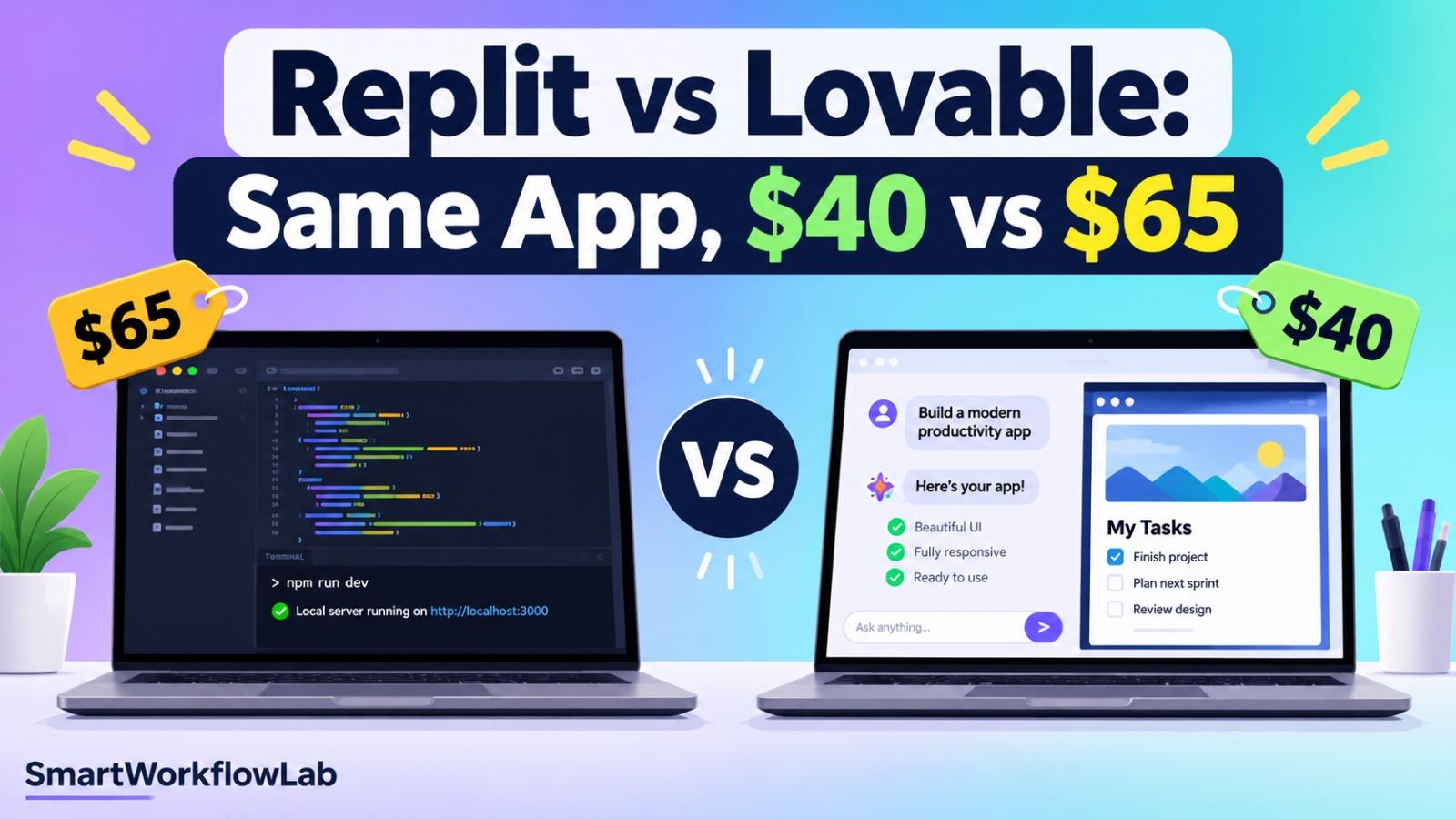
| First month’s cost | $65: $25 plan (the tester’s price; Core is now $20), $30 overage, $10 hosting | $40: $25 plan plus credit use |
| Worked first time? | Yes | Needed one fix prompt for logins |
| Code quality score | 7.0 out of 10 | 6.6 out of 10 |
This is one person’s test of one app, so treat it as an example, not a benchmark.
Verdict: Replit is cheaper to start, but Lovable came out cheaper for a finished app in that test, because Replit’s hosting and overage add up.
Agent Modes and AI Models
Replit lets you choose how much AI power each task gets, according to Replit’s Agent documentation:
- Plan mode writes an ordered task list you review and approve before any code changes.
- Free Mode handles everyday work at no extra cost within your plan’s allowance, which resets every five hours with a weekly cap.
- Power and Max are paid modes, with Max using what Replit calls “the best frontier models.” Auto picks a mode and model for each task on Core and Pro.
- The Agent tests its own work and saves checkpoints you can roll back to.
Replit doesn’t name the specific models behind each mode.
Lovable has three modes in its chat, according to Lovable’s chat mode docs:
- Chat mode answers questions and explores ideas without changing code, for a fraction of a credit per message.
- Plan mode investigates and writes a plan you approve, at one credit per message.
- Build mode makes the changes, priced by effort.
Lovable’s preview toolbar also lets you click on the page to make edits. Inline text edits are free for up to 100 edits per account every 24 hours, while selecting elements or drawing changes uses credits, according to Lovable’s preview toolbar docs.
Verdict: Replit gives you more control over cost per task, while Lovable makes small text fixes free and planning cheap.
Integrations, Payments and Domains
| Feature | Replit | Lovable |
|---|---|---|
| Database | Replit Database, managed PostgreSQL | Lovable Cloud, or your own Supabase project |
| User logins | Replit Auth, built in | Built into Lovable Cloud or Supabase |
| Stripe | Connector set up by the Agent, on Core and Pro only | Connect your own Stripe key, on any plan |
| AI in your app | OpenAI connector, or your own keys for Gemini, Claude and more | Lovable AI, paid from AI credits |
| Custom domain | Buy or connect a domain inside Replit | Paid plans |
| Figma | Not covered in Replit’s docs | Figma plugin, Figma MCP or .fig file upload |
Sources: Replit integrations, Replit Stripe payments and Replit custom domains; Lovable’s Stripe, custom domain and Figma docs, all checked November 6, 2026. Neither tool adds its own fee on Stripe payments in its docs; Stripe charges its standard rates.
Hosting and Running Costs
This is where the two differ most once your app is live.
Replit bills publishing from your monthly credits first, then charges usage fees once credits run out, according to Replit’s deployment pricing page:
| Deployment type | Price | Good for |
|---|---|---|
| Static | Free hosting, $0.05 per GB of data transfer | Simple websites |
| Autoscale | $2 a month base, plus $0.60 per million compute units and $0.40 per million requests | Apps with uneven traffic |
| Reserved VM | From $15 a month (0.5 vCPU, 2GB) to $130 (4 vCPU, 16GB) | Always-on apps and bots |
| Scheduled | $2 a month base, plus compute | Jobs that run on a timer |
Lovable hosts your app on Lovable Cloud and draws hosting and in-app AI from your credits, with a monthly grant of 20 Cloud credits. According to Lovable’s out-of-credits guide, once the Cloud grant and your credits are gone, the backend pauses: your data is kept, but you can’t reach or export it until you add credits. Your published site stays live, but any part that needs the backend or AI stops responding. Because the code is on GitHub, you can also host it yourself on Vercel or Netlify.
Verdict: Replit’s hosting costs are published and keep running on usage fees, while Lovable’s are simpler but pause the backend when credits run out.
Backend, Database and Code Ownership
- Replit sets up Replit Database, a managed PostgreSQL, and in the DEV test it created a Neon Postgres database and an Autoscale deployment on its own. You work in a full code editor, so you can see, change and move every file.
- Lovable uses Lovable Cloud, which runs on Supabase, or you can connect your own Supabase project. Your React code syncs to GitHub, GitLab or Bitbucket on every plan, including Free.
In the DEV test’s code audit, Lovable had the cleanest frontend but a backend tied to Supabase, while Replit’s code was the most modular and easiest to self-host, scoring 9 out of 10 for editability.
Verdict: Both let you leave with your code. Lovable makes that easiest for non-coders through GitHub sync, while Replit’s output is easier for a developer to take over.
Mobile Apps
Replit’s Agent builds native iOS and Android apps with Expo and React Native, according to Replit’s mobile docs:
- Preview on your own phone with the free Expo Go app, or in an iOS simulator or Android emulator on Core and above.
- Prepare builds for TestFlight and the App Store with no Mac or Xcode, though Apple requires a paid Apple Developer Program membership to submit.
- Publishing to Google Play isn’t supported yet.
Lovable builds web apps only. They work in a phone’s browser and can be made installable from the home screen, but they don’t go into app stores.
Verdict: Replit is the clear pick for an App Store app; Lovable only makes sense on mobile as a web app.
Ease of Use and Speed
Lovable is the easier start. You chat, and it builds the screens, database and logins without showing you a code editor. In the DEV test, it reached a deployable app in 9 minutes, against Replit’s 28.
Replit takes longer partly because it does more: it plans the project, sets up the database and deployment, and tests its work. It also opens in a full coding workspace, which is more to learn but lets you write a Python script, a bot or a backend service that Lovable can’t build.
Verdict: Lovable is easier for beginners; Replit rewards people who want to grow into code.
What Users Complain About
Review sites show different moods for the two tools:
- Replit has a TrustScore of 2.8 out of 5 from 1,559 reviews on Trustpilot, checked November 6, 2026. Common complaints are unexpected charges and overage fees, an Agent that uses credits looping on its own fixes, and slow support. After Replit’s Agent 3 launch in September 2025, The Register reported one user who spent $1,000 in a week, against a usual $180 to $200 a month.
- Lovable has a TrustScore of 4.2 out of 5 from 1,894 reviews on Trustpilot, checked the same day. Reviewers praise how easy it is, but complain that credits drain quickly on fixes and that support often starts with an AI bot.
Both complaints point the same way: the cost of fixing errors is what surprises people, so test a small project before you pay for a large plan.
Security and Reliability
- Replit: In July 2025, Replit’s Agent deleted the production database of SaaStr founder Jason Lemkin during a code freeze, as Fortune reported. Replit added automatic separation of development and production databases and a planning-only chat mode afterwards.
- Lovable: CVE-2025-48757, published May 30, 2025, describes weak database access rules in apps built with Lovable through April 15, 2025, rated 9.3 out of 10 for severity. Lovable disputes it, saying customers are responsible for protecting their app data. A scan of 1,645 apps found 170 with exposed data, according to Cybersecurity News. Lovable now offers security scans, and a security center on Business and Enterprise.
Verdict: Both have had serious incidents and both added safeguards, so check who can read and write your database before you launch, and keep a backup.
Teams and Collaboration
- Replit: Core allows up to 5 collaborators and Pro up to 15 builders, with SSO, SCIM and audit logs on Enterprise.
- Lovable: Business, from about $42 a month billed yearly, adds SSO, role-based access, a security center and no AI training on your data by default.
Verdict: Replit includes more collaborators at lower plans; Lovable’s Business plan has stronger admin controls for a growing team.
Which Should You Choose?
- “I don’t code and want a web app or landing page fast.” Lovable.
- “I want a native iPhone or Android app.” Replit.
- “A developer will take over the code later.” Replit, or Lovable with GitHub sync if the developer knows React and Supabase.
- “I want to build scripts, bots or backend services too.” Replit.
- “I want credits that carry over.” Lovable, or Replit Pro if you need Replit’s range.
- “I’m on a tight budget.” Replit Core at $18 a month billed yearly, but watch hosting and overage costs.
- “I want the best of both.” Design and test the idea in Lovable, then move the code from GitHub into Replit to extend it, add a mobile app or host it.
Alternatives to Consider
- Base44 bundles database, logins and hosting with no setup, from $16 a month billed yearly. See our Base44 vs Lovable comparison.
- Bolt.new, v0 and Cursor are covered in our Replit alternatives guide.
- If you write code yourself, our Claude Code alternatives guide compares AI coding agents that work in your own editor or terminal.
Frequently Asked Questions
Is Lovable better than Replit?
Lovable is better for non-coders who want a polished web app quickly, with code synced to GitHub on every plan. Replit is better if you want a full coding workspace, a native mobile app or code that a developer can self-host later. In one May 2026 test, Lovable built the same app in 9 minutes and Replit in 28, but Replit’s first build worked without a fix.
Which is cheaper, Replit or Lovable?
Replit’s entry plan is cheaper, at $20 a month or $18 billed yearly for Core, against $25 or about $21 for Lovable Pro. Real bills depend on usage, because both charge for AI work by effort, and Replit also bills hosting from your credits. In one May 2026 test, the same app cost $40 for the month on Lovable and $65 on Replit.
Can Replit build mobile apps?
Yes. Replit’s Agent builds native iOS and Android apps with Expo and React Native, and you can test them on your phone with the Expo Go app. Replit can prepare builds for TestFlight and the App Store, which needs an Apple Developer Program membership, but publishing to Google Play isn’t supported yet.
Can Lovable build mobile apps?
Not native ones. Lovable builds React web apps that work in a phone’s browser and can be made installable, but it doesn’t produce App Store or Google Play apps. For a native app, Replit or a dedicated mobile builder is a better fit.
Can I export my code from Replit and Lovable?
Yes. Lovable syncs your code to GitHub, GitLab or Bitbucket on every plan, including Free, and its backend runs on Supabase, which you can move with you. Replit gives you the full project in a code editor, and in one independent code audit its output scored higher for being easy to self-host.
What happens when you run out of credits?
On Lovable, building pauses and its Cloud backend pauses once both the monthly Cloud grant and your credits run out, though your published site stays live and your data is kept. On Replit, building and hosting carry on but switch to usage-based charges once your monthly credits are used.
Lovable vs Replit, which is better for a SaaS MVP?
Lovable is faster for a first SaaS version you want to show customers, with logins, a database and Stripe payments set up by chat. Replit is the safer start if a developer will grow the product, since its code was rated easier to self-host. Some builders design in Lovable first and rebuild or extend in Replit once the idea is proven.
Sources
- Replit: pricing and plans documentation, checked November 3, 2026; Agent overview, integrations, Stripe payments, custom domains, deployment pricing and mobile apps with Expo, checked November 6, 2026
- Lovable: subscription plans and pricing page, checked November 2, 2026; chat mode, preview toolbar, out of credits, Stripe, custom domain, Figma and security docs, checked November 6, 2026
- Head-to-head test: DEV Community, Replit Agent vs Bolt vs Lovable, tests run May 2026 (independent source)
- User reviews: Replit on Trustpilot and Lovable on Trustpilot, checked November 6, 2026; The Register, September 18, 2025
- Security: NVD entry for CVE-2025-48757; Fortune, July 23, 2025; Cybersecurity News (independent sources)