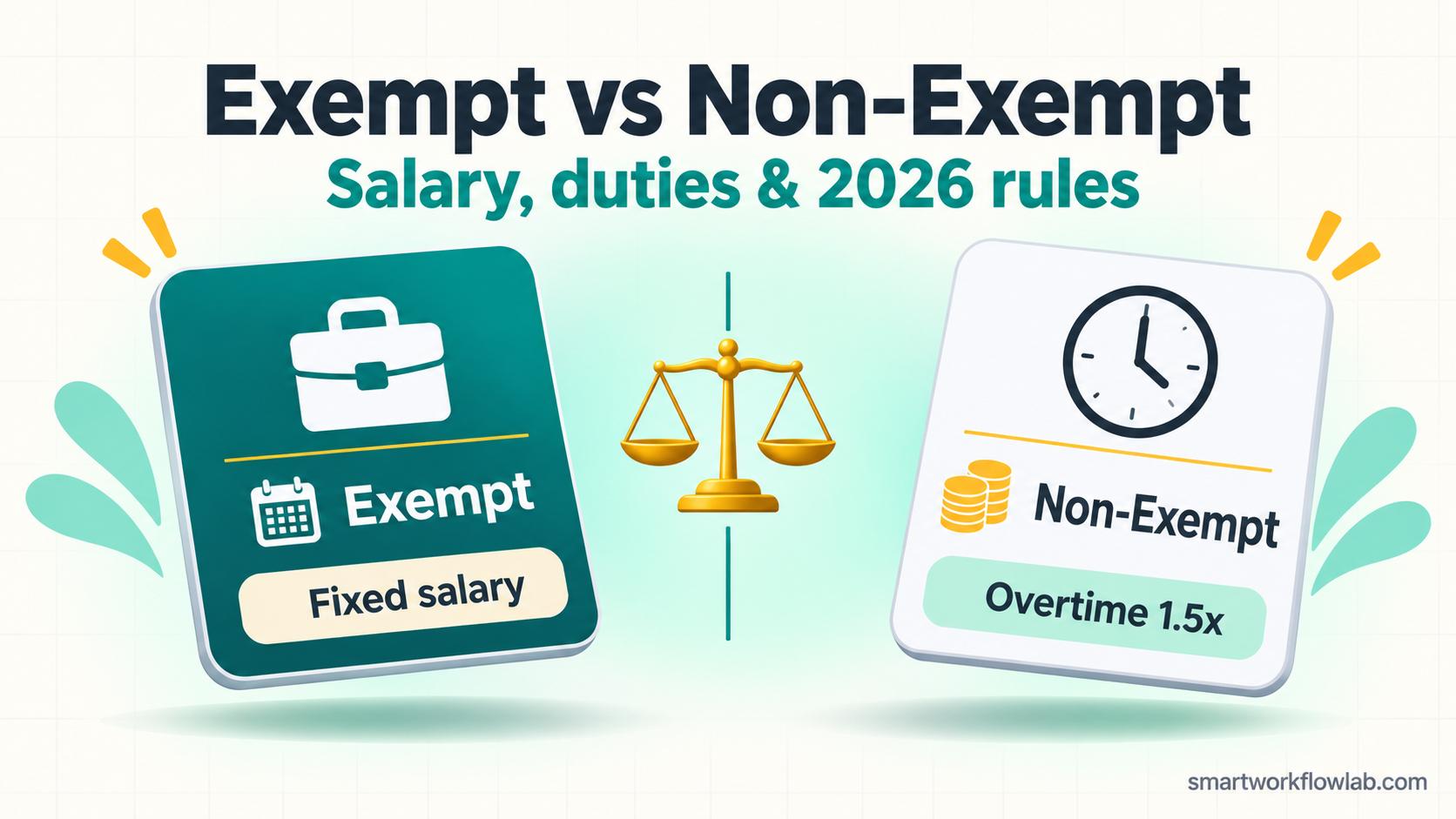
Non-exempt employees must be paid overtime, at least 1.5 times their regular rate for every hour over 40 in a workweek. Exempt employees aren’t owed overtime. To be exempt under federal law in 2026, an employee generally must be paid a salary of at least $684 a week ($35,568 a year) and do executive, administrative or professional work. Several states set much higher salary levels.
How we put this together: We read the Department of Labor’s Fact Sheets #17A and #17G and its May 14, 2026 announcement restoring the federal salary level, then checked 2026 and 2027 state thresholds against state labor departments, and against employment law firm updates where a state hasn’t published its own, named next to each figure. We checked everything on November 7, 2026. This is general information, not legal advice. Exemption depends on the facts of each job, so confirm with your state labor department or an employment lawyer before you classify anyone.
Changelog: November 7, 2026: published with 2026 thresholds and the 2027 figures already announced by California, Washington and Alaska. We update this page each January 1 and July 1.
Exempt vs Non-Exempt at a Glance
| Question | Exempt | Non-exempt |
|---|---|---|
| Overtime pay | Not required | 1.5x regular rate over 40 hours a week |
| How they’re usually paid | Salary | Hourly, or salary plus overtime |
| Minimum pay (federal, 2026) | $684 a week salary | Minimum wage for every hour |
| Duties test | Must do exempt duties | None |
| Hours tracked | Not required by federal law | Employer must record hours worked |
| Pay in a short week | Full salary in most cases | Paid for hours worked |
| Typical jobs | Managers, accountants, engineers, lawyers | Retail, warehouse, admin assistants, nursing assistants |
| Federal “no tax on overtime” | Not eligible | Eligible for qualified overtime, 2025–2028 |
The difference between exempt and non-exempt employees is overtime: non-exempt employees are covered by the overtime rules of the Fair Labor Standards Act (FLSA), the federal law on minimum wage and overtime, and exempt employees are excluded from them.
What Is an Exempt Employee?
An exempt employee is excluded from the FLSA’s minimum wage and overtime rules. According to the Department of Labor’s Fact Sheet #17A, most exempt employees must pass three tests:
- Salary basis: they’re paid a fixed salary that doesn’t drop because of the quality or quantity of work.
- Salary level: the salary is at least $684 a week.
- Duties: their main job is exempt executive, administrative or professional work.
An exempt employee who works 55 hours in a week gets the same salary as in a 40-hour week.
What Is a Non-Exempt Employee?
A non-exempt employee is covered by the FLSA, so they must get at least the federal minimum wage for every hour worked and overtime of at least 1.5 times their regular rate for hours over 40 in a workweek. Most hourly workers are non-exempt, but so are salaried workers who fail the salary level or duties test.
Some states also require daily overtime: Alaska and California after 8 hours in a day, and Colorado after 12. To work out what that overtime is worth, including state daily overtime and the 2026 overtime tax deduction, use our overtime calculator.
The Three Tests for Exempt Status
1. The salary basis test
An exempt employee must get their full, predetermined salary for any week in which they do any work, whatever the number of days or hours worked. Employers can deduct from it only in limited cases set out in the regulations, such as full-day absences for personal reasons, unpaid disciplinary suspensions of full days for workplace conduct violations, and unpaid leave under the Family and Medical Leave Act, according to the DOL’s Fact Sheet #17G.
Docking salary for a partial day off is generally an improper deduction. The exception is unpaid FMLA leave, which can be deducted by the hour. Docking pay for days when the employee is ready to work but there’s no work is also improper. Employers can take a partial day from a PTO or vacation bank, as long as the salary itself isn’t cut.
An employer with an “actual practice” of improper deductions loses the exemption for everyone in the same job under the same managers for that period, according to Fact Sheet #17G. An isolated mistake that the employer repays doesn’t cost the exemption. An employer also keeps the exemption if it has a clearly communicated policy against improper deductions with a way to complain, repays any improper deductions and commits to stop making them, under the safe harbor in 29 CFR 541.603(d).
2. The salary level test
The federal salary level is $684 a week, or $35,568 a year. On May 14, 2026, the Department of Labor announced a technical amendment, effective on publication in the Federal Register, that removed the vacated 2024 rule and restored the 2019 regulations, which “require that most exempt executive, administrative, and professional employees be paid a salary of at least $684 per week,” according to its news release.
- Nondiscretionary bonuses, incentive pay and commissions paid at least once a year can count toward up to 10% of the $684.
- Highly compensated employees earning at least $107,432 a year in total, including at least $684 a week in salary, need to perform only one exempt duty regularly.
3. The duties test
Job titles don’t decide exempt status. “Job titles do not determine exempt status,” according to Fact Sheet #17A. What counts is the employee’s primary duty:
| Exemption | Primary duty | Example |
|---|---|---|
| Executive | Runs the business or a department; directs 2+ full-time staff; hiring and firing input | Store manager |
| Administrative | Office work running the business, with independent judgment on significant matters | HR manager |
| Learned professional | Advanced knowledge from prolonged study in science or learning | Accountant |
| Creative professional | Invention, imagination or talent in an artistic field | Journalist |
| Computer employee | Systems analysis, programming, software design or testing | Software engineer |
| Outside sales | Making sales away from the employer’s premises | Field sales rep |
The duties are set out in 29 CFR 541.100 (executive), 541.200 (administrative), 541.300 (professional), 541.400 (computer) and 541.500 (outside sales).
Fact Sheet #17A also sets two firm limits. Manual and blue-collar workers such as carpenters, electricians and mechanics are “not exempt under the Part 541 regulations no matter how highly paid they might be.” Police officers, firefighters and paramedics aren’t exempt “regardless of rank or pay level.”
Exempt Salary Threshold 2026 and 2027 by State
The FLSA sets a floor. When a state sets a higher salary level, employers in that state must meet the higher one.
| State | Weekly | Yearly |
|---|---|---|
| Washington | $1,541.70 | $80,168.40 |
| California | $1,352 | $70,304 |
| NYC, Long Island, Westchester | $1,275 | $66,300 |
| New York, rest of state | $1,199.10 | $62,353.20 |
| Alaska (from July 1, 2026) | $1,120 | $58,240 |
| Colorado | $1,111.23 | $57,784 |
| Maine | $871.16 | $45,300.32 |
| Federal (all other states) | $684 | $35,568 |
Sources: Washington from Washington L&I; California from L&E Global, citing the state’s Department of Industrial Relations; New York from Proskauer; Colorado from the CDLE’s COMPS Order #40; Alaska from HiveDesk’s Alaska guide; Maine from Overtime-FLSA’s 2026 state guide, as Maine’s labor department hasn’t published the figure; federal from the DOL. Puerto Rico, the U.S. Virgin Islands, Guam and the Northern Mariana Islands use $455 a week, and American Samoa $380.
Already announced for 2027
| State | From | Weekly | Yearly |
|---|---|---|---|
| Washington (51+) | Jan 2027 | $1,773 | $92,196 |
| Washington (1–50) | Jan 2027 | $1,595.70 | $82,976.40 |
| California | Jan 2027 | $1,392 | $72,384 |
| Alaska | July 2027 | $1,200 | $62,400 |
Washington’s figures depend on employer size: 51 or more employees, or 1 to 50.
Washington’s large employers move from 2.25 to 2.5 times the minimum wage in 2027, and small employers follow in 2028, according to Washington L&I. California’s figure comes from the Department of Industrial Relations, and Alaska’s from its $15 minimum wage on July 1, 2027, according to HiveDesk. Colorado, New York and Maine hadn’t published final 2027 figures when we checked; we’ll add them when they do.
A few state details trip people up:
- California and Washington tie the threshold to the state minimum wage, at 2 times and 2.25 times a full-time minimum wage salary.
- Hourly computer professionals must earn at least $59.96 an hour in Washington, $58.85 in California and $34.85 in Colorado in 2026, against the federal $27.63, according to Washington L&I, California’s Department of Industrial Relations and Overtime-FLSA. In 2027 they rise to $62.06 in Washington and $61.03 in California. California also requires hourly-paid doctors to earn at least $107.17 an hour.
- California’s duties test is stricter: an exempt employee must spend more than half their working time on exempt duties, while the federal test looks at the main duty, not a percentage. California also has no highly compensated employee shortcut.
- Local minimum wages don’t count: in California, only the state minimum wage sets the exempt salary, so higher city minimum wages, such as San Francisco’s, don’t raise it.
- New York’s higher thresholds apply to the executive and administrative exemptions. For the professional exemption, New York uses the federal $684, according to Proskauer.
- Alaska’s level was $1,040 a week until June 30, 2026, and rose with the state minimum wage on July 1.
Most states that raise the threshold also raise it each January, so check your state labor department’s site at the start of every year. Our overtime calculator’s salary tab checks a salary against the federal, California and Colorado levels.
Are Salaried Employees Exempt or Non-Exempt?
It depends on the job, not the salary. This is the most common mix-up.
- Salaried non-exempt: a receptionist paid $40,000 a year who answers phones and greets visitors is salaried but non-exempt, because the job fails the duties test. They’re owed overtime for hours over 40.
- Salaried but under the threshold: a manager paid $650 a week fails the federal salary level, so they’re non-exempt even with management duties. In California, a manager paid less than $1,352 a week is non-exempt.
- Hourly exempt: a computer employee paid at least $27.63 an hour under federal law can be exempt. Doctors, lawyers and teachers are exempt with no salary requirement at all, and outside sales employees don’t have to meet the salary test either.
Pros and Cons for Employees
| For the employee | Exempt | Non-exempt |
|---|---|---|
| Pay | Predictable salary every week | Paid for every hour; overtime at 1.5x |
| Long weeks | No extra pay, however many hours | Every hour over 40 earns time and a half |
| Short weeks | Full salary in most cases | Paid only for hours worked |
| Flexibility | Often more control over schedule | Hours usually tracked by clock or timesheet |
| Career signal | Usually professional or management roles | Usually hourly or support roles |
Which pays more? It depends on your hours. A $55,000 salary for a 50-hour week works out to about $21.15 an hour. A non-exempt worker on $22 an hour working the same 50 hours earns $1,210 a week, or about $62,920 a year, because the last 10 hours are paid at $33.
Exempt vs Non-Exempt and Taxes
Exempt status has nothing to do with income tax. Exempt and non-exempt employees pay the same federal income tax, Social Security and Medicare.
Two tax points still matter:
- “Exempt” on a W-4 is different. Claiming exemption from federal income tax withholding on Form W-4 is a tax choice. It has nothing to do with FLSA exempt status.
- The overtime deduction only helps non-exempt workers. For tax years 2025 to 2028, workers can deduct the half-time premium of overtime required by the FLSA (hours over 40 in a workweek), up to $12,500, or $25,000 on a joint return. It phases out above $150,000 of modified adjusted gross income ($300,000 joint). Overtime owed only under state law, such as California’s daily overtime, or under a contract or company policy doesn’t count, and neither does voluntary extra pay to exempt employees, according to the IRS guidance summarised by EY. From 2026, employers report qualifying overtime on the W-2 in box 12 with code TT. Our overtime calculator estimates the deduction.
Federal Employees
Federal government employees are also classified as FLSA exempt or non-exempt, but the U.S. Office of Personnel Management sets the rules under its own regulations, 5 CFR Part 551, rather than the Department of Labor’s. Your FLSA status should appear on your SF-50 personnel action form.
Common Classification Mistakes
- Making everyone salaried to avoid overtime. Salary alone doesn’t make a job exempt.
- Going by job title. An “office manager” who mostly does data entry is non-exempt.
- Forgetting state thresholds. A $50,000 salary passes the federal test but fails in California, Washington, Alaska and Colorado, and fails in New York for managers and administrative staff. New York’s professional exemption uses the federal $684.
- Docking partial days. Cutting an exempt employee’s salary for a half-day off is an improper deduction, and making a habit of it can cost the exemption.
- Not reviewing every January. State thresholds rise with minimum wages each year.
What misclassification costs: an employer that wrongly treats an employee as exempt can owe unpaid overtime for up to two years, or three years for willful violations, under 29 U.S.C. 255, plus an equal amount in liquidated damages and the employee’s attorney’s fees under 29 U.S.C. 216(b). State laws can add their own penalties.
An illustrative example: a manager paid $600 a week, below the $684 level, who works 50 hours a week is owed overtime. If the salary covers 40 hours, that’s $15 an hour, so 10 hours at $22.50 is $225 a week. Over two years that’s $23,400, doubled to $46,800 with liquidated damages, before attorney’s fees. Courts can calculate back pay differently, so treat this as a rough guide.
If you think you’ve been misclassified, keep a record of your hours and duties, raise it with HR, and if that doesn’t resolve it, contact the DOL’s Wage and Hour Division at 1-866-487-9243 or your state labor department.
How to Check an Employee’s Status
- Check the salary. Is it at least $684 a week, or your state’s higher level?
- Check how it’s paid. Is it a fixed salary that doesn’t change with hours or output?
- Check the primary duty against the six exemptions in the duties table above.
- If any answer is no, treat the employee as non-exempt: track hours and pay overtime.
- Write it down. Keep a short record of why each role is exempt and review it every January.
To check a salary against the federal, California and Colorado levels in seconds, use the salary tab of our overtime calculator.
Frequently Asked Questions
What is the difference between exempt and non-exempt employees?
Non-exempt employees are covered by the Fair Labor Standards Act’s overtime rules, so they must get at least 1.5 times their regular rate for hours over 40 in a workweek. Exempt employees are excluded from those rules, so they get no overtime pay. To be exempt, most employees must earn a salary of at least $684 a week and do exempt duties.
Does exempt mean salaried?
Not exactly. Most exempt employees must be paid a salary, but being salaried doesn’t make you exempt. A salaried employee who earns under $684 a week or doesn’t do exempt executive, administrative or professional duties is non-exempt and is owed overtime. A few exempt groups, such as computer employees at $27.63 an hour and doctors, lawyers and teachers, can be paid hourly.
What is the salary threshold for exempt employees in 2026?
The federal level is $684 a week, or $35,568 a year, after the Department of Labor restored the 2019 rule in May 2026. Several states set higher levels, including Washington at $80,168.40, California at $70,304, New York City and its suburbs at $66,300, and Colorado at $57,784 a year. The higher threshold applies, and California and Washington have already announced higher levels for 2027.
Should I be exempt or non-exempt?
You don’t choose; the law decides based on your salary and duties. Exempt roles give a predictable salary and often more flexibility, but no overtime pay however long you work. Non-exempt roles pay for every hour and 1.5 times your rate over 40 hours. Which pays more depends on your hours. At the same effective hourly rate, non-exempt pays more once you regularly work over 40 hours.
Do exempt employees pay different taxes?
No. Exempt and non-exempt refer to overtime rules, not income tax. Both pay the same federal income, Social Security and Medicare taxes. Being exempt from overtime is different from claiming exempt from withholding on a W-4. For 2025 to 2028, only non-exempt workers can use the federal deduction for qualified overtime pay.
Can a part-time employee be exempt?
Yes, but the salary level isn’t reduced for fewer hours. Under federal law a part-time exempt employee still needs a salary of at least $684 a week, and in California at least $1,352 a week in 2026, as well as exempt duties.
Can exempt employees get overtime pay?
Yes, if the employer chooses. Paying an exempt employee extra for long weeks, at straight time or time and a half, doesn’t cost the exemption as long as the guaranteed salary is still paid, under 29 CFR 541.604(a). The law just doesn’t require it.
Can an employer change me from exempt to non-exempt?
Yes, if your job still meets the law. Employers can reclassify an exempt employee as non-exempt at any time, and must do so if your salary falls below the threshold or your duties no longer qualify. Moving someone from non-exempt to exempt is only allowed if both the salary and duties tests are met.
What happens if an employer misclassifies an employee as exempt?
The employer can owe unpaid overtime for up to two years, or three years for willful violations, plus an equal amount in liquidated damages under the Fair Labor Standards Act. State laws can add penalties. Employees can file a complaint with the Department of Labor’s Wage and Hour Division at 1-866-487-9243.
Sources
- U.S. Department of Labor: Fact Sheet #17A, exemptions for executive, administrative, professional, computer and outside sales employees; Fact Sheet #17G, salary basis; news release on restoring the 2019 salary level, May 14, 2026
- Washington Department of Labor & Industries: 2026 minimum wage and exempt salary and 2027 minimum wage and exempt salary
- California Department of Industrial Relations: 2027 minimum wage and exempt salary and computer software employee rates; L&E Global on 2026 California rates
- Colorado Department of Labor and Employment: COMPS Order #40
- Alaska: HiveDesk, Alaska minimum wage and exempt salary
- IRS overtime deduction guidance: EY summary of the August 2026 FAQ update
- Proskauer: New York 2026 minimum wage and exempt salary updates
- Overtime-FLSA: states with higher exempt salary levels in 2026 and Colorado computer employees
- U.S. Code: 29 U.S.C. 255 and 29 U.S.C. 216
- All sources checked November 7, 2026.