

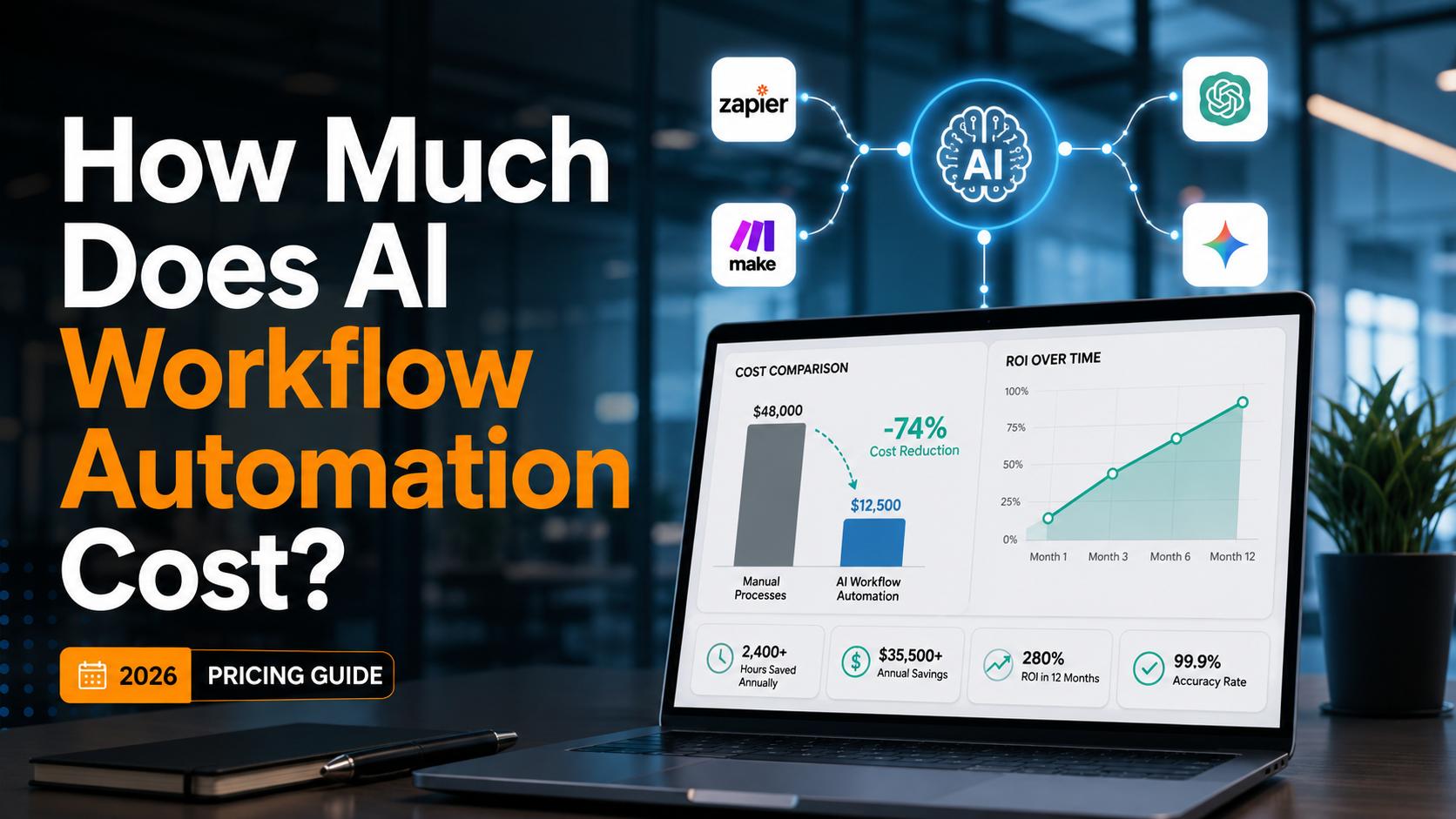
How Much Does AI Workflow Automation Cost? (2026 Pricing Guide)
“It depends” is the honest answer to almost every pricing question in automation — and it’s also the answer that leaves business owners with absolutely nothing to plan a budget around.
So this guide does the more useful thing: it breaks down what AI workflow automation actually costs in 2026, across the range of options a business realistically has — from a $20-a-month off-the-shelf tool to a six-figure custom build — and explains what pushes the price in either direction. Pricing across this market changes often, so treat the numbers here as a current, realistic range rather than a fixed quote, and always confirm current rates directly with a vendor before budgeting.
The Short Answer
For a simple setup using off-the-shelf tools like Zapier, Make, or n8n, most small businesses spend somewhere between $10 and $100 a month in software costs, plus either their own time or a few thousand dollars in one-time setup help to build the workflows.
For a custom AI automation project — one that involves a language model interpreting documents or messages rather than just moving data between apps — implementation costs typically start in the low five figures and can run into six figures for a multi-workflow, multi-department build, on top of ongoing software or model usage costs.
Enterprise-grade automation spanning multiple departments, with compliance requirements and audit logging built in, generally lands in the low-to-mid six figures for implementation, plus ongoing licensing and support.
The rest of this guide breaks down where those numbers come from.
Two Very Different Cost Categories
Before pricing anything, it helps to separate two categories that get lumped together constantly, because they cost very differently.
Simple, rule-based automation connects existing apps and moves data between them based on fixed triggers — “when a new lead comes in, add it to the CRM and notify sales.” Tools like Zapier, Make, and n8n handle this well, and pricing here is driven mostly by usage volume (how many actions run per month).
AI-driven automation goes further, using a language model or document-understanding system to interpret unstructured input — reading an email to understand intent, extracting data from an invoice regardless of layout, or deciding how to route a support ticket based on its actual content. This category costs more because it requires model usage, prompt or logic development, and typically more testing to get reliable.
As a rough rule of thumb, AI-driven automation tends to cost several times more than simple rule-based automation for a comparable number of workflows, largely because of the added development and model-usage cost. Understanding which category your process actually needs — covered in more depth in our RPA vs AI Automation guide — is the single biggest factor in getting an accurate cost estimate.
Off-the-Shelf Automation Platform Pricing
These platforms are the starting point for most small and mid-sized businesses because they require no custom development for straightforward workflows.
| Platform | Free Tier | Entry Paid Tier | Mid Tier | Notes |
|---|---|---|---|---|
| Zapier | 100 tasks/month, 2-step workflows only | Around $20–30/month for roughly 750 tasks | Around $100+/month for 2,000 tasks and team features | Broadest app library; pricing is task-based and can climb quickly at volume |
| Make | 1,000 operations/month | Around $9–16/month for a moderate operations allowance | Around $29+/month for team features | Operation-based pricing tends to be more cost-efficient for complex, multi-step workflows |
| n8n | Self-hosted free (no task limits) | Cloud plans starting around $24/month | Higher tiers for pro features | Self-hosting suits technical teams wanting predictable cost without per-task billing |
| Microsoft Power Automate | Limited free tier | Around $15/month per user (Premium) | Scales per user | Per-user pricing; strongest when your stack is already built around Microsoft 365 |
| UiPath (RPA) | Basic plan available at a low monthly cost | Custom quotes for standard/professional tiers | Enterprise: custom quote | Priced differently from the others — built for RPA on legacy systems without APIs, often needs a developer to configure |
For a small team running a handful of straightforward workflows, monthly software cost typically lands somewhere between $10 and $100. The bigger cost driver at this tier usually isn’t the software subscription — it’s the time spent building and maintaining the workflows, whether that’s done in-house or outsourced.
Implementation and Setup Costs
Software pricing is only part of the picture. Someone has to actually build the workflows, and that cost varies enormously based on complexity.
Simple automation setup — connecting a few apps with off-the-shelf tools, one to three workflows — typically runs a few thousand dollars if outsourced, or a few days of internal time if handled in-house, and can often go live within two to six weeks.
Custom AI automation — building a system that reads documents or messages, interprets them, and takes multi-step action, typically across three to ten workflows — generally starts in the low five figures and can run into six figures depending on the number of integrations and how much custom logic is required, with implementation often taking two to four months.
Enterprise-grade automation — cross-department systems with compliance requirements, audit logging, and human review workflows built in — typically runs from the low six figures upward, reflecting the added governance, monitoring, and integration work regulated environments require.
These are broad ranges, not quotes — the actual number for your business depends heavily on how many systems need to be connected, how clean your existing data is, and how much of the process is genuinely variable versus predictable.
What Actually Drives the Cost Up or Down
Number of workflows. Each additional process adds development, testing, and maintenance time — costs rarely scale linearly with volume.
Data quality. Clean, consistent source data is faster and cheaper to automate around than messy, inconsistent data that needs extra validation logic.
Number of integrations. Connecting to three well-documented, modern SaaS tools costs less than connecting to ten systems, some of which may be older platforms without a modern API.
Degree of variability in the input. A process where every document looks the same is cheaper to automate than one where formats vary constantly — that variability is exactly what pushes a project from simple automation into AI-driven automation territory.
Compliance and audit requirements. Regulated industries — healthcare, finance, insurance — need audit trails, access controls, and often human review checkpoints built in from the start, which adds real cost.
Build vs. buy. Off-the-shelf platforms are cheaper upfront but can become more expensive over time at high usage volume; custom builds cost more initially but can be cheaper to run long-term once volume is high enough to justify the investment.
Ongoing model usage. For AI-driven workflows that call a language model repeatedly, ongoing usage costs scale with volume — this is worth estimating early, since it’s easy to underbudget for the running cost, not just the build cost.
Comparing the Cost of Automation to the Cost of Not Automating
It’s easy to look at a five-figure implementation quote and treat it as the whole story, without weighing it against the actual cost of continuing to do the work manually.
A full-time employee dedicated largely to manual data entry or document processing typically costs an employer well into the tens of thousands of dollars a year once salary, benefits, and overhead are included — an ongoing cost that recurs every year, unlike a one-time automation build. That doesn’t mean automation always wins the comparison; it means the comparison is worth actually running with your own numbers, rather than assuming either side is automatically cheaper.
A useful way to frame it: calculate your current cost per document, transaction, or interaction under manual processing, multiply by your monthly volume, and compare that recurring number against the automation’s setup cost plus its ongoing software or model usage cost. For high-volume, repetitive processes, automation often pays for itself within months. For low-volume or highly variable processes, the math is less clear-cut, and it may not be worth automating yet.
How to Budget for AI Workflow Automation
- Start with one process, not a full transformation. A focused pilot keeps the initial investment proportional to the proven value before you commit to a larger rollout.
- Get quotes based on your actual workflow, not a generic estimate. The ranges in this guide are a starting point for a conversation, not a substitute for scoping your specific process.
- Budget for ongoing costs, not just setup. Software subscriptions, model usage, and periodic maintenance all continue after the initial build.
- Separate “must automate now” from “nice to have.” Prioritize the highest-volume, highest-cost manual process first.
- Ask vendors what happens at higher volume. Task- or operation-based pricing can escalate quickly — understand the cost curve before you’re locked into a platform.
- Factor in the cost of doing nothing. A quote that looks expensive in isolation may still be cheaper than a year of continued manual processing at your current volume.
Frequently Asked Questions
How much does AI workflow automation cost for a small business? For simple, off-the-shelf automation, most small businesses spend $10 to $100 a month in software costs, plus either internal time or a few thousand dollars in setup help for the initial build.
How much does custom AI automation cost? Custom AI automation, involving a language model interpreting documents or messages across several workflows, typically starts in the low five figures for implementation and can run into six figures for more complex, multi-integration builds.
Is AI automation more expensive than traditional automation? Generally yes. AI-driven automation, which interprets variable or unstructured input, typically costs several times more than simple rule-based automation because it requires model usage and more development and testing to get reliable.
What’s the biggest factor in AI automation pricing? The number of workflows, the quality of your existing data, and how much the input actually varies from case to case are usually the biggest cost drivers, more than the specific platform chosen.
Do I need to pay for AI model usage separately from software? For AI-driven workflows that call a language model, yes — ongoing usage costs typically scale with volume and are separate from any platform subscription fee, so it’s worth budgeting for both.
How long does it take to see ROI on AI workflow automation? It varies by process, but high-volume, repetitive processes with an easily measured manual cost — like invoice processing — often show payback within a few months. Lower-volume or highly variable processes take longer to justify, if they’re worth automating at all.
Are free automation tools good enough for a real business? Free tiers are useful for testing and proof-of-concept work, but most have tight limits — capped monthly actions, limited workflow complexity — that make them impractical for actual production use once your volume grows.
Is it cheaper to build automation in-house or hire an outside partner? It depends on whether you have the technical skill in-house already. Off-the-shelf tools are accessible enough for many teams to build simple workflows themselves; custom AI automation usually benefits from experienced implementation help to avoid costly missteps.
Does enterprise-grade AI automation really cost six figures? For automation spanning multiple departments with compliance and audit requirements built in, yes — that scope typically starts in the low six figures, reflecting the added governance, monitoring, and integration work involved.
How do I get an accurate quote for my business? Document your specific process first — volume, systems involved, and how much the input actually varies — then get quotes based on that, rather than relying on a generic industry range like the ones in this guide.
Conclusion
AI workflow automation doesn’t have one price tag — it has a range that depends almost entirely on how complex and variable your specific process is. A simple, well-defined workflow can be automated for the cost of a few subscriptions and a weekend of setup. A genuinely complex, document-heavy, multi-department process is a real project with a real budget behind it.
The mistake to avoid isn’t picking the wrong number off this page — it’s skipping the step of actually mapping your process and its true manual cost before you start shopping for a solution.
If you want an honest estimate for your specific situation rather than a generic range, that’s exactly the conversation SmartWorkflowLab has with businesses every week. We look at your actual workflow and volume, and tell you plainly what it would realistically cost — and whether automating it is worth it yet.
Want a real number, not a guess? Talk to SmartWorkflowLab about a workflow and cost assessment — no obligation, just a clear-eyed estimate based on your actual process.
SEO Package
SEO Title: How Much Does AI Workflow Automation Cost? (2026 Pricing Guide) | SmartWorkflowLab
Meta Description: Real 2026 pricing for AI workflow automation — from $20/month tools to six-figure custom builds — and what actually drives the cost up or down.
Slug: ai-workflow-automation-cost-pricing-guide-2026
Canonical URL: https://smartworkflowlab.com/ai-workflow-automation-cost-pricing-guide-2026
Focus Keyword: How Much Does AI Workflow Automation Cost
Secondary Keywords: AI Workflow Automation Pricing, AI Automation Cost, Workflow Automation Software Pricing, Business Automation Solutions Cost, AI Automation for Small Business Cost
OG Tags:
- og:title — How Much Does AI Workflow Automation Cost? (2026 Pricing Guide)
- og:description — A realistic breakdown of what AI workflow automation actually costs in 2026, from off-the-shelf tools to custom builds.
- og:type — article
- og:url — https://smartworkflowlab.com/ai-workflow-automation-cost-pricing-guide-2026
- og:image:alt — Cost comparison chart showing off-the-shelf automation tools versus custom AI automation pricing tiers
Twitter Tags:
- twitter:card — summary_large_image
- twitter:title — How Much Does AI Workflow Automation Cost? (2026 Pricing Guide)
- twitter:description — Real pricing ranges for AI workflow automation in 2026, from $20/month tools to six-figure custom builds.
Recommended Images:
| Image | Placement | Suggested Filename | Alt Text | Caption |
|---|---|---|---|---|
| Featured hero image | Top of article | ai-workflow-automation-cost-guide-2026.webp | Business owner reviewing an automation pricing comparison on a laptop | What AI workflow automation actually costs in 2026 |
| Pricing tier comparison chart | “Off-the-Shelf Automation Platform Pricing” section | automation-platform-pricing-comparison-2026.webp | Chart comparing Zapier, Make, n8n, and Power Automate pricing tiers | Off-the-shelf automation platform pricing compared |
| Cost driver diagram | “What Actually Drives the Cost Up or Down” section | ai-automation-cost-drivers-diagram.webp | Diagram showing factors that increase or decrease AI automation cost | What pushes AI automation pricing higher or lower |
| ROI comparison chart | “Comparing the Cost of Automation to the Cost of Not Automating” section | automation-vs-manual-cost-comparison.webp | Chart comparing the cost of manual processing versus automated processing over time | Automation cost versus the ongoing cost of manual work |
Image Title: AI Workflow Automation Cost Guide 2026
Image Caption: Real 2026 pricing ranges for AI workflow automation, from off-the-shelf tools to custom enterprise builds.
JSON-LD: Article Schema
{
  "@context": "https://schema.org",
  "@type": "Article",
  "headline": "How Much Does AI Workflow Automation Cost? (2026 Pricing Guide)",
  "description": "A realistic breakdown of what AI workflow automation actually costs in 2026 — from off-the-shelf tools to custom builds — with real pricing ranges and what drives them.",
  "author": {
    "@type": "Organization",
    "name": "SmartWorkflowLab",
    "url": "https://smartworkflowlab.com"
  },
  "publisher": {
    "@type": "Organization",
    "name": "SmartWorkflowLab",
    "logo": {
      "@type": "ImageObject",
      "url": "https://smartworkflowlab.com/logo.png"
    }
  },
  "mainEntityOfPage": {
    "@type": "WebPage",
    "@id": "https://smartworkflowlab.com/ai-workflow-automation-cost-pricing-guide-2026"
  },
  "datePublished": "2026-07-15",
  "dateModified": "2026-07-15",
  "image": "https://smartworkflowlab.com/images/ai-workflow-automation-cost-guide-2026.jpg",
  "keywords": "How Much Does AI Workflow Automation Cost, AI Workflow Automation Pricing, AI Automation Cost, Workflow Automation Software Pricing"
}
JSON-LD: FAQ Schema
{
  "@context": "https://schema.org",
  "@type": "FAQPage",
  "mainEntity": [
    {
      "@type": "Question",
      "name": "How much does AI workflow automation cost for a small business?",
      "acceptedAnswer": {
        "@type": "Answer",
        "text": "For simple, off-the-shelf automation, most small businesses spend $10 to $100 a month in software costs, plus either internal time or a few thousand dollars in setup help for the initial build."
      }
    },
    {
      "@type": "Question",
      "name": "How much does custom AI automation cost?",
      "acceptedAnswer": {
        "@type": "Answer",
        "text": "Custom AI automation, involving a language model interpreting documents or messages across several workflows, typically starts in the low five figures for implementation and can run into six figures for more complex builds."
      }
    },
    {
      "@type": "Question",
      "name": "Is AI automation more expensive than traditional automation?",
      "acceptedAnswer": {
        "@type": "Answer",
        "text": "Generally yes. AI-driven automation typically costs several times more than simple rule-based automation because it requires model usage and more development and testing to get reliable."
      }
    },
    {
      "@type": "Question",
      "name": "What's the biggest factor in AI automation pricing?",
      "acceptedAnswer": {
        "@type": "Answer",
        "text": "The number of workflows, the quality of your existing data, and how much the input actually varies from case to case are usually the biggest cost drivers."
      }
    },
    {
      "@type": "Question",
      "name": "Do I need to pay for AI model usage separately from software?",
      "acceptedAnswer": {
        "@type": "Answer",
        "text": "For AI-driven workflows that call a language model, yes — ongoing usage costs typically scale with volume and are separate from any platform subscription fee."
      }
    },
    {
      "@type": "Question",
      "name": "How long does it take to see ROI on AI workflow automation?",
      "acceptedAnswer": {
        "@type": "Answer",
        "text": "High-volume, repetitive processes with an easily measured manual cost often show payback within a few months. Lower-volume or highly variable processes take longer to justify."
      }
    },
    {
      "@type": "Question",
      "name": "Are free automation tools good enough for a real business?",
      "acceptedAnswer": {
        "@type": "Answer",
        "text": "Free tiers are useful for testing, but most have tight limits on monthly actions and workflow complexity that make them impractical for production use once volume grows."
      }
    },
    {
      "@type": "Question",
      "name": "Is it cheaper to build automation in-house or hire an outside partner?",
      "acceptedAnswer": {
        "@type": "Answer",
        "text": "It depends on in-house technical skill. Off-the-shelf tools are accessible enough for many teams to build simple workflows themselves; custom AI automation usually benefits from experienced implementation help."
      }
    },
    {
      "@type": "Question",
      "name": "Does enterprise-grade AI automation really cost six figures?",
      "acceptedAnswer": {
        "@type": "Answer",
        "text": "For automation spanning multiple departments with compliance and audit requirements built in, yes — that scope typically starts in the low six figures."
      }
    },
    {
      "@type": "Question",
      "name": "How do I get an accurate quote for my business?",
      "acceptedAnswer": {
        "@type": "Answer",
        "text": "Document your specific process first — volume, systems involved, and how much the input varies — then get quotes based on that, rather than relying on a generic industry range."
      }
    }
  ]
}
JSON-LD: Breadcrumb Schema
{
  "@context": "https://schema.org",
  "@type": "BreadcrumbList",
  "itemListElement": [
    {
      "@type": "ListItem",
      "position": 1,
      "name": "Home",
      "item": "https://smartworkflowlab.com"
    },
    {
      "@type": "ListItem",
      "position": 2,
      "name": "Guides",
      "item": "https://smartworkflowlab.com/guides"
    },
    {
      "@type": "ListItem",
      "position": 3,
      "name": "How Much Does AI Workflow Automation Cost? (2026 Pricing Guide)",
      "item": "https://smartworkflowlab.com/ai-workflow-automation-cost-pricing-guide-2026"
    }
  ]
}