Introduction
Every enterprise runs on paperwork. Invoices, contracts, claims forms, purchase orders, ID documents, medical records — they all move through your business every single day, and most of them still get read, sorted, and typed into systems by hand.
That manual work is expensive, slow, and error-prone. It’s also the reason so many operations, finance, and HR teams feel permanently behind.
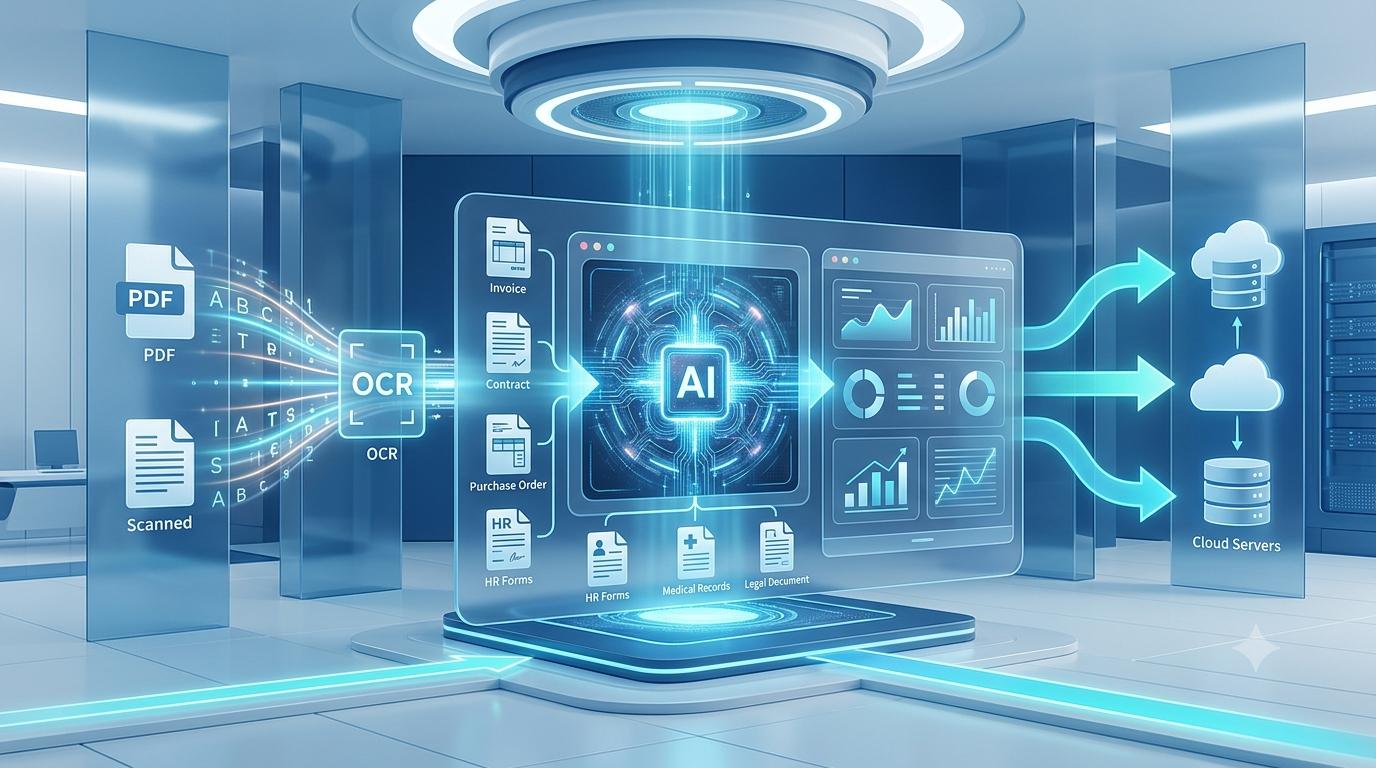
Intelligent Document Processing (IDP) is the technology category built to fix this. It combines OCR, machine learning, natural language processing, and computer vision to read documents the way a trained employee would — then classify them, extract the data, validate it, and hand off clean information to the systems that need it.
This guide breaks down what IDP actually is, how it works under the hood, where it delivers real ROI, and how to roll it out without the common missteps that stall so many automation projects. If you’re evaluating IDP for your organization in 2026, this is the guide to read before you talk to a vendor.
Table of Contents
- What is Intelligent Document Processing?
- Why Businesses Need IDP
- How Intelligent Document Processing Works
- OCR vs Intelligent Document Processing
- The AI Technologies Behind IDP
- Benefits of Intelligent Document Processing
- Real Business Examples by Industry
- Implementation Roadmap
- Best Practices
- Common Challenges and Mistakes
- ROI Analysis
- Future Trends in IDP for 2026
- Frequently Asked Questions
- Conclusion
What is Intelligent Document Processing?
Intelligent Document Processing is a category of software that uses artificial intelligence to automatically read, understand, and extract information from documents — structured, semi-structured, and unstructured — and turn that information into usable, structured data.
The word “intelligent” is doing real work in that name. Traditional OCR software can turn a scanned page into text. IDP goes several steps further: it identifies what kind of document it’s looking at, understands the context of the fields on the page, pulls out the relevant data points, checks them against business rules, and routes the result into your ERP, CRM, or line-of-business system — largely without a human touching it.
Think of IDP as the layer that sits between “a document lands in your inbox” and “the correct data is now in your system of record.”
Why Businesses Need IDP
Most mid-size and large organizations process thousands, sometimes millions, of documents a year. Finance teams key in invoices. HR teams process onboarding paperwork. Insurance teams review claims. Banks process loan applications. Logistics teams handle bills of lading and customs forms.
Manual document handling creates three compounding problems:
- Cost. Skilled staff spend hours on repetitive data entry instead of higher-value work.
- Speed. Manual review creates bottlenecks that slow down invoice payment, claims resolution, and customer onboarding.
- Accuracy. Human data entry has an error rate that adds up fast at volume, and errors downstream (in accounting, compliance, or claims) are expensive to fix.
IDP addresses all three at once. It doesn’t just digitize documents — it removes the manual step of interpreting them, which is where most of the time and cost actually sits.
There’s also a talent dimension that often gets overlooked. Skilled accountants, HR specialists, and claims adjusters didn’t join their profession to spend their day retyping numbers from PDFs into a system. Repetitive data entry is one of the top drivers of burnout and turnover in back-office roles. When a business automates the extraction step, it’s not just cutting cost — it’s freeing experienced staff to do the analytical, judgment-based work they were actually hired for, which tends to improve retention as well as output quality.
There’s a growing regulatory angle too. In industries like healthcare, banking, and insurance, document accuracy isn’t just an efficiency question — it’s a compliance requirement. A misread account number or an incorrectly transcribed diagnosis code can trigger downstream compliance issues that are far more expensive to fix than the original document would have been to process correctly. Built-in validation rules and audit trails, which are standard in mature IDP platforms, give compliance and audit teams a level of traceability that manual processing simply can’t match.
Finally, there’s the customer and vendor experience angle. Slow invoice approvals delay vendor payments and can damage supplier relationships. Slow claims processing frustrates policyholders at the exact moment they need support the most. Slow onboarding creates a poor first impression for new employees. In each case, the document processing step is invisible to the end customer or employee — but the delay it causes is not.
How Intelligent Document Processing Works
A typical IDP pipeline moves through five stages:
1. Ingestion. Documents arrive from email, scanners, mobile uploads, APIs, or shared drives, in formats ranging from PDFs and scanned images to Word files and faxes.
2. Classification. The system identifies the document type — invoice, purchase order, ID card, claim form — often before it even looks at individual fields. This matters because an invoice and a contract need completely different extraction logic.
3. Extraction. Using OCR combined with machine learning models, the system pulls out specific data fields: vendor name, invoice number, total amount, patient ID, policy number, and so on — regardless of whether the layout matches a template the system has seen before.
4. Validation. Extracted data is checked against business rules, reference databases, or historical patterns. A total that doesn’t match the sum of line items, or a vendor that isn’t in the approved list, gets flagged.
5. Human-in-the-loop review. Low-confidence extractions are routed to a human reviewer for a quick check, rather than blocking the entire pipeline. Over time, these corrections feed back into the model, improving accuracy on future documents.
The result: a clean, structured record — ready to post into your accounting system, HR platform, or claims engine — with an audit trail behind it.
It’s worth walking through what this looks like in practice. Say an accounts payable inbox receives 400 invoices in a single day, arriving as PDF attachments, scanned images, and the occasional photo taken on a phone. An IDP system ingests all of them automatically, without anyone opening a single email. It classifies each one as an invoice rather than a packing slip or a statement, then extracts vendor name, invoice number, date, line items, tax amount, and total. Each extracted value carries a confidence score. Fields extracted with high confidence flow straight through; anything below the confidence threshold — a smudged total, an unfamiliar vendor format — gets routed to a reviewer’s queue with the relevant field highlighted, so the reviewer isn’t re-reading the whole document, just confirming or correcting one number.
Once validated, the clean data posts directly into the accounting system, often already matched against the corresponding purchase order. What used to take a team of data-entry clerks the better part of a day now runs in the background, with human attention reserved for the small percentage of documents that genuinely need it.
OCR vs Intelligent Document Processing
This is one of the most common points of confusion, so it’s worth being precise about it.
| Capability | Traditional OCR | Intelligent Document Processing |
|---|---|---|
| Converts image to text | Yes | Yes |
| Understands document type | No | Yes |
| Extracts specific data fields | Limited, template-based | Yes, context-aware |
| Handles varied layouts | Poorly | Well |
| Validates extracted data | No | Yes |
| Learns from corrections | No | Yes |
| Routes data into business systems | No (usually manual) | Yes, automated |
| Handles handwriting reasonably well | Rarely | Often, depending on model |
OCR answers the question “what characters are on this page?” IDP answers a much more useful question: “what does this document mean, and where does this data need to go?”
The AI Technologies Behind IDP
IDP isn’t one algorithm — it’s a stack of complementary AI technologies working together.
Machine Learning underpins classification and extraction. Models are trained on large sets of labeled documents to recognize patterns — what an invoice number typically looks like, where a total usually sits on the page, which words signal a shipping address versus a billing address.
Natural Language Processing (NLP) helps the system understand meaning, not just position. NLP is what lets IDP correctly interpret a clause in a contract or classify a paragraph in a legal filing, rather than relying purely on where text sits on the page.
Computer Vision handles the visual side: detecting tables, signatures, stamps, checkboxes, and layout structure, even on documents that are skewed, low-resolution, or handwritten.
Intelligent OCR is an evolution of traditional OCR that’s layout-aware and can handle multiple languages, fonts, and formats with much higher accuracy than legacy engines.
Document Classification models sort incoming files by type automatically, which is what lets an IDP system process a mixed batch of invoices, POs, and receipts without manual pre-sorting.
Data Extraction and Validation work together as the core “brain” of the system — pulling structured data out and immediately checking it for consistency and correctness.
Human-in-the-loop design isn’t a weakness in the AI — it’s a deliberate safety net. The best IDP systems are built to escalate uncertainty to a person rather than guess, and to learn from that correction.
It helps to see how these pieces work together on a single document rather than in isolation. Take a scanned insurance claim form. Computer vision first detects the page layout — where the form fields, tables, and signature box sit, even if the scan is slightly rotated or the page has a coffee stain in the corner. Intelligent OCR then reads the characters within each detected region, adjusting for the specific font and handwriting style. Machine learning classification confirms this is a claim form and not a related document like a police report or a medical bill that happened to be scanned in the same batch. NLP then interprets any free-text sections — the claimant’s description of what happened — and extracts key details like date of loss and claim type from that narrative, not just the labeled fields. Finally, validation logic cross-checks the policy number against the active policy database and flags the claim for review if the policy has already lapsed.
No single technology in that list could complete the task on its own. It’s the combination — vision to find the data, OCR to read it, ML to classify it, NLP to understand context, and validation to sanity-check it — that makes IDP meaningfully different from any single-purpose tool that came before it.
Benefits of Intelligent Document Processing
- Faster processing times — documents that took days to process manually can often be completed in minutes.
- Lower operating costs — less manual data entry means lower per-document processing cost.
- Higher accuracy — validation rules catch errors before they hit downstream systems.
- Better compliance and audit trails — every extraction and correction is logged.
- Scalability — volume spikes (tax season, open enrollment, peak shipping periods) don’t require hiring temporary staff.
- Improved employee experience — staff shift from repetitive keying to exception handling and higher-value work.
- Faster customer experience — quicker invoice approvals, claims decisions, and onboarding.
Real Business Examples by Industry
Invoice Processing. Finance teams use IDP to extract vendor details, line items, and totals from invoices in any format, matching them automatically against purchase orders — a process known as three-way matching — and flagging discrepancies for review instead of processing every invoice manually. This is usually the first workflow businesses automate, because invoices are high-volume, arrive in predictable-enough formats, and the cost of manual processing is easy to quantify.
HR Documents. Onboarding packets, ID verification documents, tax forms, and background check paperwork can be processed automatically, pulling structured employee data directly into HR information systems. Beyond speed, this reduces the compliance risk of missing or mis-keyed fields on forms like I-9s or W-4s, which HR teams are ultimately accountable for.
Healthcare Records. Hospitals and clinics use IDP to digitize patient intake forms, insurance cards, referral letters, and lab reports, reducing transcription errors that can affect both patient care and billing accuracy. Because so much healthcare documentation is still handwritten or faxed, IDP systems built for this sector need to handle lower-quality source material than a typical corporate invoice.
Banking Documents. Loan applications, KYC (Know Your Customer) documents, pay stubs, and account opening forms are processed and cross-checked against compliance databases far faster than manual review allows, which shortens the time from application to funding decision — a metric that directly affects customer satisfaction and conversion.
Insurance Claims. Claims forms, medical bills, repair estimates, and supporting documentation are classified and extracted automatically, shortening the claims cycle and reducing the manual review backlog that frustrates policyholders during what is often already a stressful moment.
Legal Documents. Contract review teams use IDP-adjacent NLP tools to extract key clauses, dates, renewal terms, and obligations from large volumes of agreements during due diligence or contract audits — work that would take paralegals weeks to do manually across a large contract portfolio.
Manufacturing and Logistics Documents. Bills of lading, packing slips, customs forms, and delivery confirmations are processed automatically to keep supply chain data accurate and up to date, which matters enormously when a single shipment delay can cascade into missed production deadlines.
Across all of these industries, the pattern is the same: the document itself hasn’t changed, but the cost of processing it manually has become harder to justify as volumes grow and customer expectations around speed increase.
Businesses adopting this technology often pair it with a broader Business Process Automation strategy, since document processing is usually just one workflow among several that benefit from automation.
Implementation Roadmap
- Audit your document volume and types. Identify the highest-volume, highest-cost document workflows first.
- Define success metrics. Processing time, cost per document, error rate, and staff hours reclaimed.
- Choose the right IDP approach. Off-the-shelf platform, custom-trained models, or a hybrid — depending on document variability.
- Start with a pilot. Pick one document type and one department. Prove the ROI before scaling.
- Build validation rules with subject-matter experts. Finance and operations staff know what “wrong” looks like — bake that into the system.
- Integrate with downstream systems. ERP, CRM, or claims platforms need clean API or connector-based integration, not manual exports.
- Establish a human-in-the-loop review process. Decide thresholds for automatic approval versus human review.
- Monitor, retrain, and expand. Use correction data to improve accuracy, then extend to additional document types.
This roadmap works well alongside a broader AI Business Automation initiative, where document intelligence becomes one building block in a larger automation strategy — something the team at SmartWorkflowLab helps organizations design end to end.
Best Practices
- Start with a narrow, high-volume use case rather than trying to automate everything at once.
- Involve the people who currently do the manual work — they know the edge cases.
- Set a clear confidence threshold for automatic processing versus human review.
- Track accuracy by document type, not just in aggregate.
- Treat human corrections as training data, not just error fixes.
- Plan for exceptions from day one; no IDP system handles 100% of documents without a fallback path.
- Review vendor claims critically — ask for accuracy benchmarks on documents similar to yours, not generic marketing numbers.
Common Challenges and Mistakes
Trying to automate everything on day one. Broad rollouts without a pilot phase tend to surface problems at the worst possible scale.
Ignoring document variability. A system tuned for clean, templated invoices may struggle with handwritten or low-quality scans from smaller vendors.
Skipping the human-in-the-loop step. Fully “lights-out” automation sounds appealing but tends to push errors downstream instead of catching them.
Underestimating integration work. Extraction is only half the job — the data still needs to flow cleanly into existing systems.
Not measuring accuracy by field. Overall accuracy numbers can hide the fact that one critical field (like invoice total) is underperforming.
Choosing a rigid, template-only tool. Template-based systems break the moment a vendor changes their invoice layout. Context-aware, ML-based extraction is far more resilient.
Underestimating change management. Even a well-built IDP system fails to deliver ROI if the team downstream doesn’t trust it enough to rely on the output. Bringing finance, HR, or claims staff into the process early — showing them how exceptions are handled, and giving them a clear escalation path — tends to matter as much as the accuracy of the model itself.
Treating the pilot as the finish line. A successful pilot on one document type proves the concept, but it’s tempting to declare victory and move on. The organizations that get the most value keep expanding IDP to adjacent document types and workflows, compounding the ROI over time rather than stopping after the first win.
ROI Analysis
The ROI case for IDP typically comes from three sources:
Labor cost reduction. Fewer hours spent on manual data entry translates directly into cost savings or capacity for higher-value work.
Cycle time improvement. Faster invoice processing improves early-payment discount capture; faster claims processing improves customer satisfaction and retention; faster onboarding reduces new-hire drop-off.
Error cost avoidance. Manual entry errors in finance, compliance, or healthcare documentation carry real downstream costs — corrections, penalties, or rework — that automation reduces significantly.
Most organizations that implement IDP on a well-chosen, high-volume workflow see payback within the first year, with invoice processing and claims processing typically delivering the fastest returns because of their volume and well-defined structure.
A simple way to frame the business case internally:
| Metric | Before IDP | After IDP (typical) |
|---|---|---|
| Processing time per document | Minutes to hours | Seconds to minutes |
| Error rate | Varies, often underestimated | Reduced significantly with validation rules |
| Staff hours on manual entry | High | Redirected to exception handling |
| Scalability during volume spikes | Requires temp staff | Handled without added headcount |
Future Trends in IDP for 2026
- Generative AI-assisted extraction, where large language models handle unstructured, free-form documents that older template-based systems couldn’t touch.
- Deeper integration with agentic workflows, where IDP is one step in a larger autonomous process — not a standalone tool.
- Better handling of multi-language and multi-format documents as global operations demand it.
- Increased focus on explainability, with systems showing exactly why a field was extracted or flagged, which matters for regulated industries.
- Continuous learning pipelines that reduce the manual retraining effort historically required to keep accuracy high.
Organizations that treat IDP as part of a broader Workflow Automation strategy — rather than a one-off tool — tend to get more value out of these advances as they arrive.
Frequently Asked Questions
Is Intelligent Document Processing the same as OCR? No. OCR converts images of text into machine-readable characters. IDP builds on OCR by adding classification, context-aware extraction, validation, and system integration.
What types of documents can IDP handle? Structured documents (like standardized forms), semi-structured documents (like invoices, which vary by vendor), and unstructured documents (like contracts or emails), depending on the sophistication of the system.
How accurate is IDP? Accuracy varies by document type and quality, but well-implemented systems with human-in-the-loop review routinely achieve high accuracy on core fields, especially after an initial tuning period.
Does IDP require IT to build custom integrations? Most modern IDP platforms offer pre-built connectors for common ERP, CRM, and HR systems, though some custom integration work is common for legacy or highly specific systems.
How long does implementation take? A focused pilot on a single document type can often go live within weeks; enterprise-wide rollouts across multiple document types typically take longer, depending on integration complexity.
Is IDP worth it for smaller businesses, or only large enterprises? Any organization processing a meaningful volume of repetitive documents — invoices, applications, claims — can see ROI, though the highest returns are typically seen at higher document volumes.
Conclusion
Intelligent Document Processing isn’t a futuristic concept anymore — it’s a practical, proven way to remove one of the most persistent bottlenecks in enterprise operations: manual document handling. The organizations getting the most out of it aren’t the ones trying to automate everything overnight. They’re the ones starting with a well-defined, high-volume use case, measuring results carefully, and expanding from there.
If you’re weighing where to start — whether it’s invoices, claims, HR documents, or something specific to your industry — the team at SmartWorkflowLab can help you map out a pilot, choose the right approach, and build an implementation plan that fits your existing systems. Reach out to SmartWorkflowLab to talk through your document workflows and see where IDP can make the biggest difference for your team.
Suggested image alt text: “Diagram showing the Intelligent Document Processing workflow from document ingestion to data extraction and system integration” Suggested image title: “Intelligent Document Processing Workflow 2026” Suggested image caption: “How Intelligent Document Processing moves a document from ingestion to structured, validated business data.”