

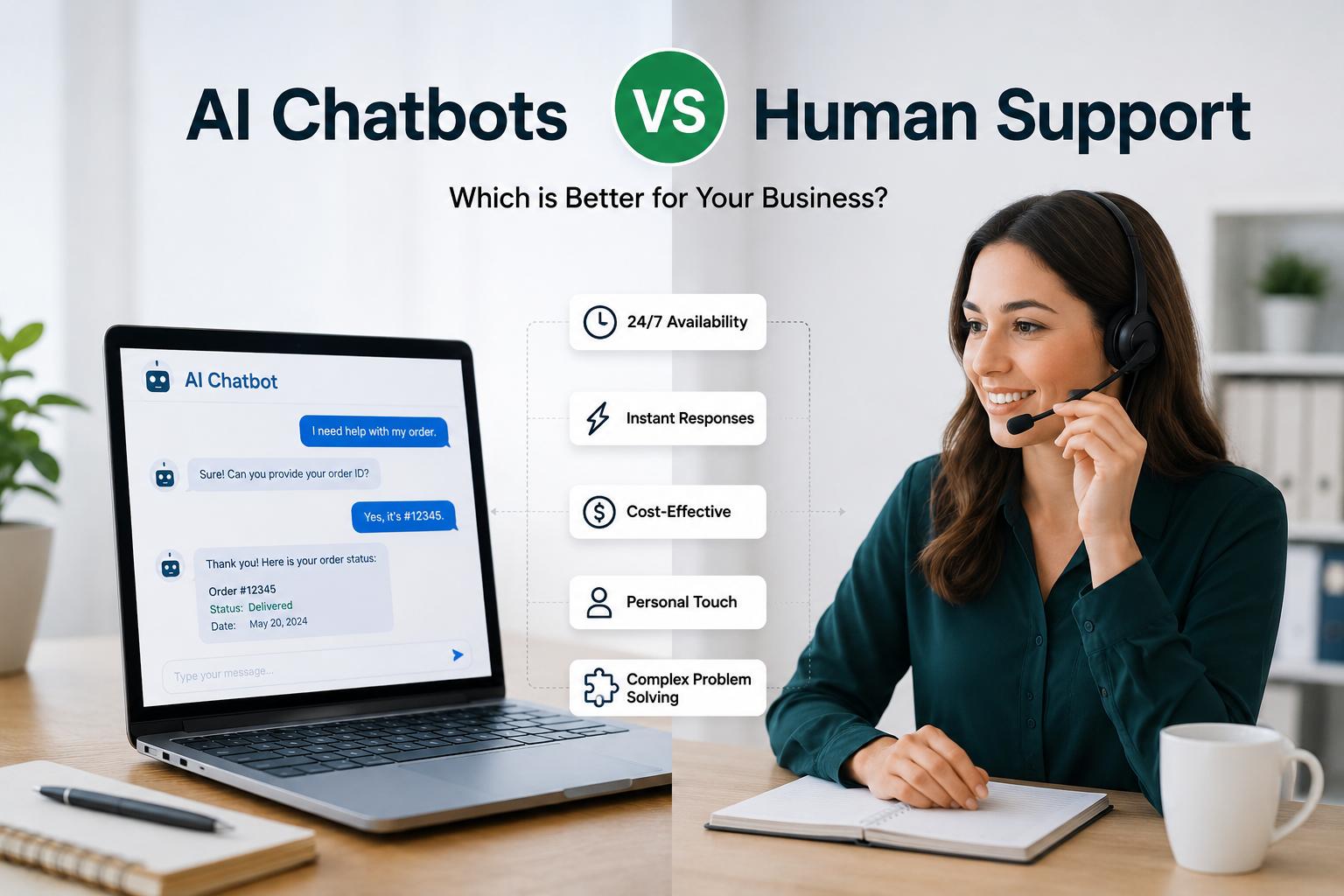
You’re getting pushed from two directions at once. One side says automate support, cut costs, deflect tickets, do more with a smaller team. The other side warns that customers already resent talking to bots and one bad automated experience can lose them for good. Both pressures are real, and “just use both” — the answer every article gives — doesn’t actually tell you what to do on Monday morning.
So let’s skip the part where we argue whether AI chatbots or human agents win. They don’t compete; they cover different jobs. The question worth your time is where you draw the line between them — and that line depends on your business, your customers, and how well you handle the moment a bot hands off to a person.
This guide walks through where that line should sit for your business, how to design the handoff so customers don’t feel dropped, why most hybrid rollouts fail, and how to measure whether yours is working. It’s written for founders, support leaders, and e-commerce and SaaS teams who want a working setup, not another “it depends” explainer. One thing to get straight up front, because it changes the whole debate: the bots of 2024 aren’t the bots of 2026.
The Real Question Isn’t “Which Is Better” — It’s “Where’s the Line”
Everyone agrees the answer is hybrid. Fine. The useful disagreement is where the human takes over, and the honest answer is that the boundary has moved — fast.
The chatbot most people picture is the old kind: a scripted decision tree matching keywords, looping you through menus, incapable of understanding a question phrased two different ways. Those were rightly hated. What’s rolling out now is different in kind, not degree. Modern support AI is built on large language models with retrieval-augmented generation (RAG), which means it pulls real answers from your actual knowledge base instead of guessing, holds context across an entire conversation, and — in its “agentic” form — takes actions: canceling a subscription, issuing a refund, updating an address, not just describing how.
Gartner’s headline forecast captures the shift: it predicts that by 2029, agentic AI will autonomously resolve 80% of common customer service issues without human intervention, cutting operational costs by around 30%. That word “common” is doing a lot of work, and we’ll come back to it — but the direction is clear.
Here’s the catch that keeps this from being hype. Gartner also predicts that more than 40% of agentic AI projects will be scrapped before the end of 2027, done in by weak data, fuzzy goals, and underestimated complexity. And its own analysts expect the pure cost argument to erode — for genuinely complex cases, AI’s cost per resolution may exceed a human’s by 2030. Translation: the technology is real, the line has moved, and most companies will still get this wrong. The ones who don’t are the ones who draw the line deliberately. Let’s do that.
What AI Chatbots Do Best
Play to what AI is actually good at, and it’s very good.
- Speed and availability — a bot answers instantly, at 3 a.m., on a holiday, to a thousand people at once. No queue, no hold music, no “we’re experiencing higher than normal volume.” For a customer who just wants a tracking number, that’s the whole job done.
- The repetitive, high-volume stuff — order status, password resets, return policies, appointment booking, “what are your hours,” basic troubleshooting, lead qualification. These are asked constantly, have clear answers, and are the work that burns out human agents fastest when they’re stuck doing it.
- Consistency and scale — every customer gets the same correct answer, and the ten-thousandth conversation costs roughly what the first one did. Humans can’t match that, and shouldn’t have to.
Real deployments bear this out. Bank of America’s virtual assistant, Erica, has handled hundreds of millions of client interactions and, when it can’t resolve something, routes to a human with full context and no re-authentication. Vodafone’s TOBi handles roughly 70% of incoming customer queries, freeing agents for the messy 30%. These aren’t science projects; they’re everyday infrastructure.
One honest caveat, because it matters more than any feature: a chatbot is only as good as the knowledge base behind it. A well-fed bot is a genuine asset. A poorly trained one is worse than no bot at all, because it answers wrong with total confidence — and customers believe it until they don’t.
What Human Support Does Best
Now flip it, and look at it from the customer’s chair — which is where these articles usually stop paying attention.
There’s a specific kind of moment where a human isn’t a nice-to-have, it’s the entire point. Your order arrived shattered and the event is tomorrow. Your card got charged twice and rent is due. Your account is locked and you can’t get in. In those moments you don’t want efficiency — you want someone who gets it, who can bend a rule, apologize like they mean it, and actually fix the thing. That’s human territory, and no amount of sentiment detection fully replaces it.
- Complex, multi-step, and unpredictable problems — when an issue spans three systems, has an exception the script didn’t anticipate, or requires judgment about what’s fair, humans improvise in ways bots can’t.
- Empathy and trust — a person can hear that you’re upset and change their whole approach: patience, reassurance, a bit of humor. That emotional read builds the loyalty that turns a near-cancellation into a renewal. Research consistently finds the same split — chatbots score higher on speed and availability, humans score higher on empathy and trust.
- High-stakes and sensitive situations — money, health, legal exposure, a furious long-time customer. These carry real downside if handled badly, and they’re exactly where you want a trained person exercising judgment.
The tradeoff is the obvious one: humans cost more, don’t scale infinitely, and can’t be everywhere at once. Which is precisely why you don’t want them buried under password resets.
AI Chatbots vs Human Support: Side by Side
Here’s the comparison at a glance before we get into how to combine them.
| Factor | AI Chatbots | Human Support |
|---|---|---|
| Response speed | Instant, no wait | Limited by availability and queue |
| Availability | 24/7/365 | Business hours, or costly shift coverage |
| Cost structure | High setup, low marginal cost per ticket | Ongoing salary, benefits, training |
| Scalability | Thousands of chats at once | Scales only by hiring |
| Consistency | Identical answer every time | Varies by person and day |
| Empathy | Simulated at best | Genuine — the real differentiator |
| Complex issues | Struggles beyond its training | Excels at judgment and improvisation |
| Setup & upkeep | Needs a strong knowledge base and maintenance | Needs hiring and onboarding |
| Best-fit work | High-volume, repetitive, clear-cut | Complex, emotional, high-stakes |
Read the table and the strategy almost writes itself: send AI everything in the top rows it dominates, and protect human time for the bottom rows where people are irreplaceable. The trick is the handoff between them — which is where most setups quietly break.
AI’s Biggest Win Might Be Helping Your Humans
Here’s the shift most companies miss. The highest-return use of AI in support may not be the bot facing your customer at all — it may be the AI sitting behind your agents, helping them.
The strongest evidence comes from Harvard Business School. Researchers Shunyuan Zhang and Das Narayandas ran a randomized field experiment on a full year of real support chats at a meal-delivery company — more than 250,000 conversations — where some agents got real-time AI response suggestions and others didn’t. The tool, trained on over 3 million past service interactions, nudged agents toward responses that offered help, apologized, validated the customer, and expressed gratitude. Agents using it responded to chats about 20 percent faster, and the improvement was even larger for less-experienced agents. It also helped them reply with more empathy and thoroughness — the human strengths that actually move satisfaction and revenue. In effect, a new hire could serve customers like someone with far more experience, almost immediately.
That’s the reframe: instead of putting AI in front of the customer to replace a person, put it behind the person to make them better. Draft-reply suggestions, instant knowledge-base lookups mid-chat, auto-summaries of a long conversation history so the agent doesn’t have to scroll, faster onboarding for new hires. The customer never sees the AI — they just get a faster, warmer, more competent human.
But the same study carries a warning that cuts to the heart of the handoff problem. When customers who had already been failed by a chatbot were then routed to an AI-assisted human, the AI’s involvement actually hurt sentiment — because the unusually fast replies made those customers think they were still stuck with a bot. The lesson is sharp: the value of AI depends entirely on context, and a botched bot experience poisons what comes after it. Which brings us to the part that makes or breaks everything.
The Escalation Playbook: How Handoffs Should Actually Work
Every article tells you to “escalate complex issues to a human.” None tell you how. This is where hybrid support is won or lost, so here’s the actual mechanics.
Know your escalation triggers. A handoff should fire on any of these: the customer explicitly asks for a person (never refuse this), frustration or negative sentiment shows up in their language, the bot fails twice on the same issue, the topic is sensitive (billing disputes, cancellations, anything emotional or high-stakes), or the account is high-value enough to warrant white-glove treatment. Define these deliberately instead of hoping the bot figures it out.
Transfer the full context — this is the big one. The single fastest way to enrage a customer is to make them re-explain their whole problem to the human after the bot already asked. When escalation happens, the agent must inherit the entire conversation: what the customer said, what the bot tried, what’s already been ruled out. The customer should feel the baton pass smoothly, not get dropped and asked to start over.
Get the timing right. Escalate too early and you waste agent time on things the bot could’ve handled. Escalate too late and the customer is already furious by the time a human arrives. Tune this by watching where conversations go sideways — if people routinely rage-quit the bot at step three, your trigger is one step too late.
Always leave the door open. Never bury “talk to a human” behind five menu layers. A visible, easy path to a person isn’t an admission the bot failed — it’s what makes customers trust the bot in the first place, because they know they’re not trapped.
Here’s the difference in practice. Bad handoff: a customer messages about a damaged order, the bot offers three unhelpful FAQ links, the customer types “agent” four times, finally reaches a human, and has to describe the whole situation from scratch. Good handoff: the bot recognizes “damaged” plus frustrated phrasing, immediately says it’s connecting a specialist, and passes the order number, photos, and chat history along. The human opens with “I’m so sorry about your order arriving damaged — I can see the photos you sent, and I’m issuing a replacement now.” Same tools, opposite outcome. The gap between them is entirely in the handoff design.
Why Most Hybrid Rollouts Fail
Gartner expects more than 40% of agentic AI projects to be cancelled before 2027. Here’s how support setups actually fail — and the fix for each.
Dead-end bot loops. The bot can’t help, and there’s no visible way out to a human. The customer spirals until they leave. Fix: a guaranteed escape hatch to a person on every flow, triggered by request or repeated failure.
Confidently wrong answers. A thin or outdated knowledge base leads the bot to invent policy that doesn’t exist — a mistake that has publicly embarrassed real brands. Fix: ground the bot in a well-maintained, current knowledge base (this is what RAG is for), and audit its answers regularly.
The hidden human option. Companies bury “contact support” to force deflection, treating a talked-to human as a failure. Customers read it as contempt. Fix: make the human path easy to find; you’ll deflect plenty on the strength of a bot that’s actually good.
Over-automation. Pushing bots into emotional or high-stakes moments — grief, money panic, a serious complaint — to save a few dollars. It reads as cold and costs you the relationship. Fix: route sensitive categories to humans by default, no matter the volume.
Set-and-forget. No owner keeps the bot current as products, prices, and policies change, so answers quietly rot. Fix: assign a specific person to own the bot’s knowledge and performance — this is a living system, not a one-time install.
How to Decide: A Framework for Your Business
There’s no universal split, so score your own situation against a few variables, then read the segment that fits.
The variables that matter: ticket volume (high volume justifies heavier automation), average order or account value (high value earns more human touch), issue complexity (the more judgment required, the more human), industry sensitivity (regulated or trust-based = human-first), and customer demographics (an older or less tech-comfortable base skews human-friendlier).
Now the segments:
E-commerce. High volume, mostly repetitive — where’s my order, how do I return this, is this in stock. Lean into AI on the front line, and reserve humans for damaged goods, disputes, and anything touching a refund or an upset customer. The bot protects your margins; the human protects your repeat-purchase rate.
SaaS. A mix of technical questions and relationship management. This is where the agent-assist reframe pays off most — helping your support team often beats a customer-facing bot, because technical troubleshooting and account relationships reward human judgment amplified by AI, not replaced by it. Automate onboarding FAQs and status checks; keep humans on churn-risk conversations.
High-trust and regulated (legal, medical, financial, high-value B2B). Human-first, full stop. Customers expect a person, and the downside of a wrong automated answer is severe. Use AI behind your team — drafting, summarizing, looking things up — and keep it off the front line for sensitive queries.
Early-stage startups. Automate cautiously. Every early support conversation teaches you what customers are confused about, what language they use, what objections they raise — intelligence you lose if a bot absorbs it all. Start with AI on the most obvious repetitive questions and keep founders close to the rest until patterns emerge.
How to Measure If Your Hybrid Setup Is Working
You can’t tune what you don’t track. Here are the numbers that tell you whether the balance is right.
| Metric | What It Tells You |
|---|---|
| Deflection rate | Share of tickets the bot resolves without a human |
| Escalation rate | How often conversations move to a person — and if it’s rising |
| First response time | Speed to first reply; AI should push this way down |
| Resolution time | How long to actually solve the issue end to end |
| CSAT, split by type | Satisfaction for bot-only vs. human-assisted chats, compared |
| Cost per ticket | Financial efficiency, watched alongside satisfaction |
The nuance nobody talks about: true vs. false deflection. A bot that “closes” a ticket looks like a win — but if the customer gave up rather than got helped, you’ve recorded a success while quietly losing them. A high deflection rate paired with sinking CSAT or customers re-opening the same issue is the tell. Always read deflection next to satisfaction, never alone.
Then act on the movement. Escalation rate climbing? Your bot’s knowledge has a gap, or a product change broke a flow. CSAT lower on bot-only chats? You’re automating something that needs a human. Cost per ticket down but repeat contacts up? You’re deflecting, not resolving. The numbers aren’t a scoreboard — they’re a map of where to adjust the line.
How [Your Company] Helps
[Your Company] works with support teams to audit where their current chatbot-and-human setup frustrates customers, redraw the line between automation and people around how the business actually operates, and design handoffs that transfer full context instead of dropping customers. That ranges from a first chatbot deployment for a small team to agent-assist tooling and escalation design for a scaling support org.
For teams planning a broader shift rather than a single fix, this usually fits under a wider customer support automation effort, where the bot, the knowledge base, and the human team are connected into one coherent system rather than bolted together.
Frequently Asked Questions
1. Will AI chatbots replace human customer support?
No — they’re reshaping the job, not eliminating it. AI is taking over the high-volume, repetitive tier, while humans move toward complex, emotional, and high-stakes work. Even Gartner’s aggressive 80%-by-2029 forecast applies only to common issues, and its own follow-up research warns the human role is more durable than early hype suggested.
2. What percentage of customer queries can AI chatbots handle?
For most businesses, well-implemented AI resolves somewhere around 60–80% of routine queries — order status, FAQs, resets, bookings. Real deployments like Vodafone’s TOBi handle roughly 70%. The exact figure depends on how repetitive your ticket mix is and how good your knowledge base is.
3. When should a chatbot hand off to a human agent?
When the customer asks for a person, when frustration shows in their language, when the bot fails twice on the same issue, or when the topic is sensitive or high-value. And whenever it hands off, it must pass the full conversation so the customer never repeats themselves.
4. Are AI chatbots cheaper than human support?
For high-volume routine work, yes — high setup cost but very low cost per ticket. But the savings are narrower than vendors claim. Gartner expects AI’s cost per resolution on complex issues to exceed human agents’ by 2030. Automate for better outcomes, not just cheaper headcount.
5. What’s the best support setup for a small business or startup?
Start by automating your most repetitive questions, keep a visible path to a human, and stay close to the conversations that teach you about your customers. Early on, over-automating costs you insight you can’t get back. Add automation as clear patterns emerge.
6. Do customers prefer chatbots or human agents?
It depends entirely on the task. For instant, simple needs, customers happily use a bot — speed wins. For complex, sensitive, or emotional issues, they strongly prefer a human. The preference isn’t for one channel; it’s for the right one at the right moment.
7. What is a hybrid customer support model?
A hybrid model uses AI chatbots for high-volume, repetitive queries and human agents for complex, emotional, or high-stakes ones — with a smooth handoff between them. The goal isn’t to pick a side but to route each interaction to whichever handles it best.
8. How do modern AI support chatbots differ from older ones?
Older bots followed scripted decision trees and matched keywords, so they broke the moment a question was phrased unexpectedly. Modern ones use large language models with retrieval-augmented generation (RAG) to pull real answers from your knowledge base, hold context across a conversation, and even take actions like issuing a refund.
Final Thoughts
The companies that win at support in 2026 aren’t the ones that picked AI or humans. They’re the ones that drew the line on purpose — automating what should be automated, protecting human time for what actually needs a person, and obsessing over the handoff in between.
And often the smartest AI investment isn’t the bot your customers see. It’s the AI behind your agents, making a good team faster and a new hire feel like a veteran. Get the line right and the handoff clean, and you stop choosing between efficiency and empathy — you get both.
Ready to get the balance right? [Your Company] helps teams map where their support experience frustrates customers most, redraw the line between AI and human agents, and build handoffs that actually work. Contact us for a free support audit, or explore our customer support automation services to see what’s possible.